Alan Keating Bluffs Tom Dwan for $194K on NGNF Live
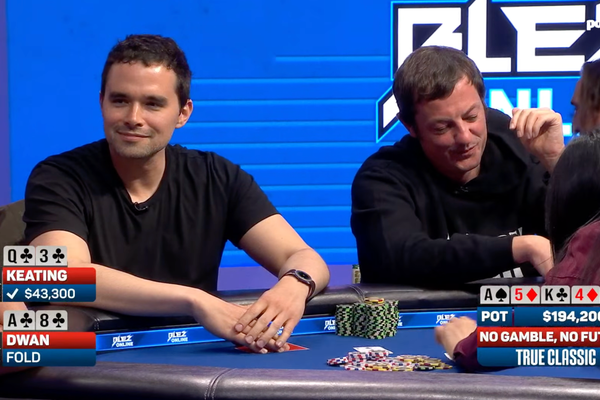
Alan Keating executed one of the boldest bluffs in televised poker history, moving all-in for $109,000 with just king-high to force Tom Dwan off the winning hand in a $194,200 pot during the debut livestream of No Gamble, No Future. The audacious play highlighted the first episode of the show’s new format, which featured a star-studded lineup battling at $100/$200 stakes with commentator Nick Wright making his dual debut both behind the mic and at the felt.
What Happened
The revamped No Gamble, No Future launched its live format from the PokerGO Studio with an impressive roster that included Tom Dwan, Phil Hellmuth, Chris Moneymaker, Shaun Deeb, Alan Keating, and Erick Lindgren. Playing $100/$200 blinds with a $200 ante and $25,000 minimum buy-in, the game immediately established its entertainment credentials.
True to his aggressive reputation, Keating arrived with $200,000 in chips—eight times the minimum buy-in—while his opponents started with the table minimum. This stack disparity set the stage for the kind of high-pressure poker that would define the session.
The marquee hand developed approximately three and a half hours into the broadcast. Dwan limped from early position holding eight-seven offsuit, facing a straddle from Deeb. Keating, sitting on the double straddle with king-jack offsuit, sensed vulnerability and raised to $7,000. Only Dwan called, creating a heads-up pot.
The flop came down ace-eight-four with two clubs, giving Dwan middle pair. Keating continued his aggression with a $10,000 bet, and Dwan flatted. Commentary analyst Jared Bleznick immediately identified the strategic wrinkle: Dwan had the Anti Big Reveal plush toy in front of him, a Wheel of Pain punishment allowing opponents to reveal one hole card.
“Look, Dwan is going to call and Alan is going to ask to see a card. Watch!” Bleznick predicted. “If Dwan produces the eight and turns that card over, Keating is going to bluff it all off because he knows he can’t beat more than an ace!”
The turn brought a five, giving Keating a gutshot straight draw to complement his two overcards. He fired $25,000, and Dwan called once more. The river completed with a blank, and that’s when Keating made his move—announcing all-in for his remaining $109,000.
Remarkably, Keating never used the card reveal option. As Dwan tanked, Bleznick grew animated in the booth: “Alan, you’re an idiot! Look at the card!” But Keating maintained his line, applying maximum pressure without gathering additional information.
After several minutes of deliberation, Dwan folded his pair of eights face-up. Keating immediately tabled his king-jack bluff, dragging the $194,200 pot in what Bleznick called “one of the most entertaining poker hands we’ve ever watched historically on televised poker history.”
The Poker Strategy Breakdown
This hand showcases multiple layers of advanced poker theory, starting with Keating’s preflop aggression. Recognizing that Dwan’s limp indicated a capped range—unlikely to contain premium hands—Keating’s isolation raise with king-jack offsuit was textbook. He leveraged position and perceived range advantage to seize control of the pot.
Keating’s continuation bet on an ace-high flop represents standard procedure when you’ve been the preflop aggressor. The ace favors his perceived range significantly more than Dwan’s limping range, allowing him to credibly represent top pair or better. Dwan’s call, however, suggested he connected with the board in some capacity.
The turn barrel becomes more interesting from a game theory perspective. Keating picked up additional equity with his gutshot, but more importantly, the five changed nothing about the relative strength of likely holdings. By maintaining pressure, Keating forced Dwan to continue defending with marginal made hands while building a pot he could potentially steal on the river.
The river shove represents the critical decision point. Keating’s all-in bet created a pot-sized wager, offering Dwan approximately 1.8-to-1 on a call. This means Dwan needed to be good roughly 36% of the time to make calling profitable. However, poker isn’t played in a vacuum—it’s played against opponents with histories and tendencies.
Keating’s decision not to use the card reveal deserves particular attention. Conventional wisdom suggests he should have looked, as seeing Dwan’s eight would have confirmed his opponent held a vulnerable one-pair hand worth bluffing against. By not looking, Keating actually strengthened his story. If he’d seen a card and then shoved, Dwan might have reasoned that Keating gained information suggesting a bluff would work. The unexplained aggression paradoxically made the bet more credible.
From Dwan’s perspective, the fold becomes understandable when considering the action. Keating fired three barrels into a player known for his calling ability and hand-reading skills. The sizing escalated dramatically, and Keating’s willingness to risk his entire stack without gathering additional information suggested genuine strength. Dwan’s middle pair, while ahead of Keating’s actual holding, faced a range weighted heavily toward aces, overpairs, and two-pair combinations.
Reading The Field & Table Dynamics
The success of Keating’s bluff didn’t occur in isolation—it was the product of carefully cultivated table dynamics and player profiling. Keating’s $200,000 starting stack sent an immediate message: he came to gamble and apply pressure. This image allows for creative plays that might not work coming from tighter players.
Dwan, despite his reputation as one of poker’s most fearless competitors, found himself in an uncomfortable spot. Playing the minimum buy-in against Keating’s massive stack created an asymmetric risk scenario. While Dwan could win Keating’s entire stack, he could also lose his own buy-in multiple times over the course of the session. This dynamic influences marginal decisions, making folds slightly more attractive when stack preservation matters.
The presence of the Anti Big Reveal toy added a meta-game element that Keating exploited brilliantly. Most players would have used the information—the fact that Keating didn’t suggested either supreme confidence or a hand strong enough that additional information was unnecessary. This psychological warfare operates at the highest levels of poker.
Nick Wright’s presence both in the commentary booth and later at the table contributed to the session’s loose atmosphere. His $17,100 loss over limited hands indicated recreational play that likely encouraged others to gamble more liberally. When the table dynamic shifts toward entertainment over pure profit maximization, creative plays like Keating’s bluff become more viable.
The livestream format itself influenced decision-making. Players aware they’re performing for an audience sometimes make different choices than they would in private games. Dwan’s willingness to show his fold—and Keating’s immediate reveal of the bluff—demonstrated both players understood the entertainment value of the moment.
How To Apply This To Your Game
While most players won’t face $100,000+ decisions, the strategic principles from this hand translate directly to games at all stakes. The most important lesson involves understanding when your range holds an advantage and leveraging that edge through aggression.
When you’re the preflop raiser, you typically represent strength. Continuation betting on flops that favor your range—like ace-high boards when you’ve raised and your opponent has called—allows you to win pots immediately while building larger pots when you actually connect. Don’t abandon this aggression just because you missed; your opponent doesn’t know that.
Multi-street bluffing requires a coherent story. Keating’s triple barrel made sense because each street told the same tale: he had a strong hand and wanted value. Random bluffs that don’t follow logical betting patterns get caught. Before firing that river bluff, ask yourself whether your betting sequence makes sense for the hands you’re representing.
Stack depth matters enormously. Keating’s deep stack allowed him to apply maximum pressure on later streets. In your games, recognize that effective stack sizes determine your strategic options. With 40 big blinds, you can’t execute the same multi-street bluffs available with 200 big blinds. Adjust your strategy accordingly.
Pay attention to opponent tendencies. Dwan’s reputation as a calling station actually worked against him here—Keating knew that if Dwan was folding, his story must be credible. Against opponents who fold too much, you can bluff more frequently. Against calling stations, you need stronger hands to barrel multiple streets.
Sometimes the information you don’t gather is as powerful as the information you do. Keating’s decision not to look at Dwan’s card created ambiguity that strengthened his bluff. In your games, be aware of how your information-gathering actions might reveal your intentions. Sometimes maintaining mystery serves you better than gaining certainty.
Key Takeaways
- Range advantage matters more than actual holdings when constructing multi-street bluffs—Keating’s preflop raise and position gave him credibility throughout the hand
- Stack depth enables aggression—Keating’s deep buy-in allowed him to apply maximum pressure on the river where shorter stacks couldn’t
- Consistent storytelling across streets makes bluffs more believable than random aggression without a coherent narrative
- Sometimes not using available information (like the card reveal) can strengthen your play by maintaining ambiguity and preventing opponents from leveling themselves
- Table dynamics and player images influence decision-making—Keating’s gambler reputation made his bluffs more credible than they might be from tighter players
- Even world-class players like Dwan make disciplined folds with winning hands when the action doesn’t make sense for their holding to be ahead
Frequently Asked Questions
Should Keating have used the card reveal before shoving the river?
Conventional wisdom suggests yes—seeing Dwan’s card would have given Keating perfect information about whether to bluff. However, by not looking, Keating actually strengthened his bluff’s credibility. If he’d looked and then shoved, Dwan might have reasoned that Keating saw something that made him think a bluff would work. The unexplained aggression paradoxically made the bet seem stronger, as it suggested Keating didn’t need information because his hand was genuinely strong.
Was Dwan’s fold correct with middle pair?
From a game theory perspective, Dwan’s fold was reasonable given the action. Keating fired three increasingly large barrels, culminating in an all-in river shove. This betting pattern heavily weights toward strong hands—aces, overpairs, or two-pair combinations. While Dwan was actually ahead, he couldn’t know that, and calling off his entire stack with middle pair against such aggression represents significant risk. Against most opponents’ river shoving ranges in this spot, middle pair is behind.
How often should you triple-barrel bluff in your games?
Triple-barrel bluffs should be relatively rare and require specific conditions: you need a credible story, appropriate stack depth, an opponent capable of folding, and a board texture that favors your perceived range. In typical low-to-mid stakes games, most players don’t fold enough to make frequent triple-barrel bluffs profitable. Focus on single-barrel and double-barrel bluffs against recreational players, reserving triple barrels for situations where you have a strong read and the betting narrative makes sense for the hands you’re representing.
Final Thoughts
Alan Keating’s $194,200 bluff against Tom Dwan exemplifies poker at its highest level—not just the technical execution, but the psychological warfare and table presence required to pull off such audacious plays. The hand demonstrates that poker success isn’t solely about cards and mathematics; it’s about understanding opponents, controlling narratives, and having the courage to pull the trigger when the situation demands it.
The debut of No Gamble, No Future’s live format provided the perfect stage for this memorable confrontation. With Nick Wright bringing fresh energy to the commentary booth and later the felt, the show established itself as must-watch content for poker fans seeking entertainment alongside high-level strategy. The session’s final results—with Erick Lindgren and Chris Moneymaker also posting significant wins—confirmed that the new format delivers on both fronts.
For players looking to elevate their game, this hand offers a masterclass in leveraging every available edge. Study not just the cards, but the context—the stack sizes, the player dynamics, the betting patterns, and the psychological elements that transform a simple king-high into a pot-winning powerhouse. That’s where poker mastery truly lives.
Ready to Sharpen Your Poker Game?
Master your poker game with expert hand analysis