Keating’s Quad Aces Demolish Palmer in $1M+ HCL Cooler
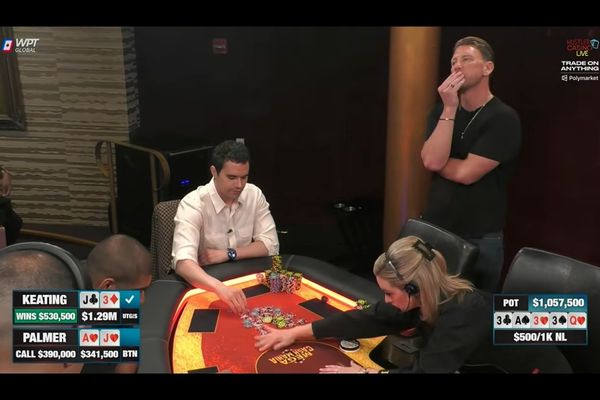
Alan Keating turned pocket aces into quad aces and extracted maximum value in a monster $1M+ pot during Hustler Casino Live’s Mega Cash Mania session. The brutal cooler left political newcomer Scott ‘Palmer’ Fuhrman questioning reality as his aces-full ran straight into Keating’s unbeatable quads, capping off one of the most dramatic hands of the high-stakes stream.
What Happened
Thursday’s Mega Cash Mania game at Hustler Casino Live delivered the kind of carnage that makes for legendary poker moments. In a $100K minimum buy-in game, Scott ‘Palmer’ Fuhrman—a former political candidate making his HCL debut—opened the action from the button with A♥K♥ for $2,000. Alan Keating, holding A♠A♦ in the straddle, three-bet to $22,000. Palmer called, setting up what would become an unforgettable confrontation.
The flop brought A♣K♠K♦, giving Palmer top two pair and Keating a well-disguised full house. Keating led out for $35,000 into the $47,000 pot, and Palmer raised to $115,000 with his kings-up. Keating called, keeping the pot manageable while holding a monster.
The turn card was the A♥—the fourth ace in the deck—completing quad aces for Keating while improving Palmer to aces-full of kings. Both players checked, with Keating masterfully setting the trap for the river.
When the 2♦ hit the river, the board showed four aces and a pair of kings, suggesting a likely chop to anyone not holding the case ace. Keating seized the moment with a massive overbet of $390,000 into the $277,000 pot. Palmer, sitting on over $800,000 in chips, went deep into the tank before standing up to process the decision. After deliberating, he announced “You can’t take it with you; I call.”
Keating tabled his quad aces, and Palmer’s reaction said everything. He immediately left the table, pacing the room and repeating “What the f**k am I supposed to f**king do there?” The pot pushed Keating over $800,000 in profit for the session, while Palmer finished down more than $600,000.
The Poker Strategy Breakdown
This hand showcases several critical strategic concepts that separate elite players from the rest of the field. Keating’s preflop three-bet with pocket aces from the straddle was standard, though the sizing to $22,000 gave Palmer attractive odds to continue with his premium suited Broadway cards.
The flop action reveals Keating’s sophisticated approach to disguised monsters. Rather than checking to trap, he led out for roughly 75% pot. This accomplishes multiple objectives: it builds the pot immediately, it looks like a continuation bet with unpaired hands, and it allows worse hands to raise for value. Palmer’s raise to $115,000 with top two pair is completely standard—he’s ahead of most of Keating’s range and needs to charge draws and build the pot.
Keating’s flat call on the flop is crucial. A reraise would likely end the action right there, with Palmer potentially folding everything except pocket kings. By calling, Keating keeps Palmer’s entire value range in play while maintaining deception about his hand strength.
The turn check from Keating after hitting quads is a masterclass in pot manipulation. With the board now showing A♣K♠K♦A♥, Palmer has improved to a full house and will almost certainly call any reasonable bet. However, Keating recognizes that Palmer might interpret a turn bet as weakness or a blocker bet, potentially shutting down action. The check keeps Palmer thinking his aces-full might still be good while setting up a river overbet.
The river overbet is where Keating’s experience shines. Betting $390,000 into $277,000 represents a 141% pot overbet—a sizing that typically polarizes a range to the absolute nuts or pure bluffs. The board texture makes this play particularly effective because it appears to be chopping. Most players would check back here, assuming their opponent also has an ace. By betting, Keating represents either a bluff or the specific holding he has. Palmer, with the second-best possible hand, finds himself in an impossible spot.
Reading The Field & Table Dynamics
Understanding the context of this hand requires examining the player dynamics and game flow. Palmer entered this game as an HCL newcomer, a former political candidate stepping into one of poker’s most scrutinized arenas. His stack of over $800,000 indicated he’d been running well or bought in deep, but his relative inexperience at this level became a factor in the hand’s conclusion.
Keating, by contrast, is a seasoned high-stakes player known for creative lines and fearless betting. His reputation at the table matters—when he makes an unusual play like this river overbet, opponents must consider whether he’s capable of turning a hand into a bluff in this spot. That history makes his value bets more effective because they’re balanced by credible bluff frequency in other situations.
The timing of this hand also matters. It occurred near the end of the streaming session, when players are often more willing to gamble and create action. Palmer’s comment “You can’t take it with you” before calling suggests he understood the entertainment value of making the call, even if he suspected he might be beaten. In a private game, he might have found a fold, but the cameras and audience create different incentives.
The stack depths also influenced the action. With effective stacks over 400 big blinds deep, there’s room for significant post-flop maneuvering. Shallow-stacked poker often sees players commit on the flop with strong hands, but deep play allows for the kind of multi-street strategy that makes this hand fascinating.
How To Apply This To Your Game
While most players won’t encounter $100K buy-in games, the strategic principles from this hand translate to any stake level. First, recognize when you have a disguised monster and adjust your line accordingly. Keating’s flop lead rather than check-raise kept Palmer’s range wide and encouraged action. When you flop an unexpected full house or better, consider lines that keep your opponent invested rather than immediately going for maximum value.
Second, practice pot control with very strong hands when you want to encourage bluffs or value bets from worse holdings. Keating’s turn check with quads might seem overly cautious, but it set up a much larger river bet than he could have extracted by betting turn and river. Sometimes the best way to build a big pot is to let your opponent think they’re in control.
Third, understand when board texture supports overbet strategies. The river card in this hand created a board that appeared to be chopping, making an overbet seem like either a bluff or the nuts. When you have the absolute best hand and the board suggests a chop to casual observers, an overbet can look like a bluff and get called by hands that would fold to a standard bet.
For players on Palmer’s side of the equation, this hand illustrates the importance of considering your opponent’s entire range, not just their likely holdings. When facing an overbet on a board that appears to chop, ask yourself: what hands would my opponent bet here? If the only logical value hands beat you, and you’re blocking many bluff combinations, finding a fold becomes correct despite holding a monster.
Finally, manage your emotional response to coolers. Palmer’s reaction—standing up, leaving the table, questioning the hand aloud—is understandable but counterproductive. Coolers happen at every level of poker. The best players process them quickly and move on, recognizing that getting your money in good is all you can control. Palmer actually played the hand reasonably well; he just ran into the one hand that crushed him.
Key Takeaways
- Disguised monsters often extract more value with non-standard lines like leading into the raiser rather than check-raising
- Turn checks with the nuts can set up larger river bets by keeping your opponent’s range wide and giving them confidence in their hand
- Overbet sizing on rivers works best when board texture suggests a chop or when you have clear polarization to nuts or air
- Stack depth fundamentally changes optimal strategy—deep play allows for sophisticated multi-street plans that shallow play doesn’t permit
- Player dynamics and table image affect how opponents perceive your unusual bet sizing, making balanced play in other spots crucial for maximizing value
- Even second-best hands can be correct calls when facing overbets, but you must carefully consider your opponent’s range and the specific board texture
Frequently Asked Questions
Should Palmer have folded aces-full to the river overbet?
Palmer’s call is defensible given the board texture and his hand strength. He holds the second-best possible hand, and many players would overbet this board as a bluff representing the case ace. However, against a player of Keating’s caliber who rarely makes this play without a legitimate hand, finding a fold has merit. The key is knowing your opponent—against unknown or aggressive players, calling is standard, but against tight players who only overbet for value, folding becomes more attractive.
Why did Keating check the turn after hitting quads?
Keating’s turn check serves multiple purposes. First, it disguises his hand strength and keeps Palmer thinking his aces-full might be good. Second, it allows Palmer to improve or gain confidence in his hand, making him more likely to call a large river bet. Third, it prevents Palmer from shutting down on the turn, which might happen if Keating bets. By checking, Keating sets up a larger river bet than he could extract by betting both turn and river.
What does this hand teach about playing in high-stakes streamed games?
Streamed games create unique dynamics where entertainment value influences decisions. Palmer’s comment before calling suggests awareness of the audience and the content being created. Players in these games often make looser calls than they would in private games because of the publicity and action expectations. Understanding these dynamics is crucial—your opponents may be more willing to gamble and less likely to make tight folds when cameras are rolling.
Final Thoughts
This hand exemplifies why poker remains endlessly fascinating—even with the second-best possible hand, Palmer found himself crushed by the absolute nuts. Keating’s patient approach and expert river execution turned a cooler into a masterclass in value extraction. The hand also demonstrates that technical skill alone isn’t enough at the highest levels; you need to understand player psychology, table dynamics, and how to manipulate pot sizes across multiple streets.
For Palmer, this brutal introduction to HCL will sting, but it’s also a valuable lesson in high-stakes poker variance. He played his hand reasonably well and got his money in with tremendous equity on the flop. Sometimes that’s not enough. The mark of a successful poker player isn’t avoiding coolers—it’s processing them quickly and maintaining optimal play afterward.
Whether you’re playing $1/$2 or $100K buy-in games, studying hands like this reveals universal truths about poker strategy. The best players don’t just play their cards—they play their opponents, manipulate pot sizes, and create situations where they extract maximum value from their monsters while minimizing losses with their bluffs. That’s the difference between winning players and champions.
Ready to Sharpen Your Poker Game?
Master your poker game with expert hand analysis