Shaun Deeb Turns Down $250K Bet Over Chicken Fingers
Shaun Deeb rejected a quarter-million dollar wager at the 2026 WSOP because the terms required him to abstain from chicken fingers for the entire summer. According to Josh Arieh’s calculations, the poker pro is effectively sacrificing $83,000 in expected value to maintain his fried poultry consumption throughout the series.
What Happened
The proposition began innocently enough. Ben Lamb and Daniel Negreanu approached Deeb with a team-versus-team wager on the $25K Fantasy league, with $250,000 on the line. The problem? Deeb believed his team held a significant edge—somewhere between 60-65%—and wanted the odds to reflect that advantage.
When Lamb and Negreanu refused to lay odds on what they considered closer to a coin flip, negotiations stalled. That’s when the conversation took an unexpected turn toward Deeb’s well-documented affinity for chicken fingers.
Lamb proposed a creative solution: he’d offer even money on the bet if Deeb agreed to forgo chicken fingers for the duration of the WSOP. The offer was declined immediately. For Deeb, apparently no amount of positive expected value justifies a summer without his favorite food.
Lamb has since taken to tracking Deeb’s chicken finger consumption on social media. Early data shows Deeb averaging approximately 1.7 chicken fingers daily. Projected across the full WSOP schedule, that puts him on pace for roughly 75 chicken fingers by series end, accounting for slower days and weekends.
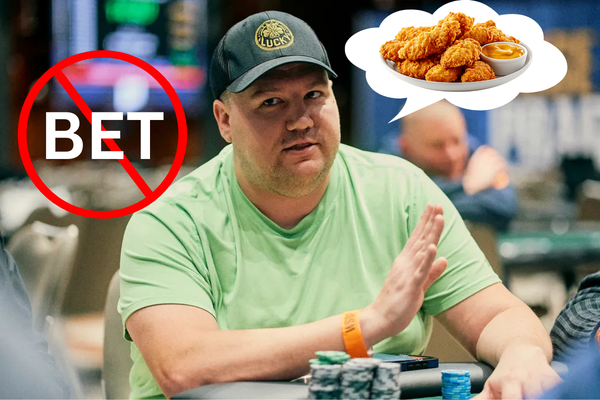
Deeb’s preferred vendors? He cited “Canes place in food at Horseshoe court Dave’s” on social media—presumably referring to Raising Cane’s, the Horseshoe food court, and Dave’s Hot Chicken, all convenient options near the tournament venue. Meanwhile, his tournament buy-in pace sits around 2.5 entries per day, potentially reaching 100 total entries by the end of summer.
The Poker Strategy Breakdown
This situation perfectly illustrates the concept of implied odds versus personal utility—though perhaps not in the traditional poker sense. When Deeb claims 60-65% equity in the fantasy league matchup, he’s essentially saying he should win this bet roughly two out of every three times if they ran it multiple times.
From a pure game theory perspective, Deeb’s position makes mathematical sense. If you genuinely hold 60% equity in a proposition, accepting even money represents negative expected value. On a $250,000 wager where you’re 60% to win, you should expect to profit $50,000 on average. Taking even money means you’re giving away $50,000 in theoretical value.
However, Lamb’s chicken finger clause introduces an interesting wrinkle. By offering even money contingent on dietary restrictions, Lamb was essentially saying: “I’ll pay you $50,000 in equity if you stop eating chicken fingers.” Arieh calculated this figure at $83,000, suggesting Deeb’s edge might be even larger than 60%.
This creates a fascinating decision tree. Does Deeb value chicken finger consumption at more than $83,000 for the summer? Apparently yes. From a strict EV maximization standpoint, this seems irrational. But poker players don’t operate purely on mathematical optimization—quality of life, routine, and mental game all factor into decision-making.
Consider the psychological element. Deeb likely has established routines during the WSOP grind. Disrupting those patterns—even for significant money—could negatively impact his tournament performance. If giving up chicken fingers puts him on tilt or disrupts his focus, the $83,000 in theoretical value could evaporate through suboptimal play.
There’s also the concept of bankroll management and risk tolerance. A $250,000 swing represents substantial variance, even for a player of Deeb’s caliber. Perhaps he’s simply not interested in that level of exposure on a side bet, regardless of the food clause. The chicken fingers might be a convenient excuse to decline a wager he wasn’t comfortable making anyway.
Reading The Field & Table Dynamics
The social dynamics at play here reveal much about high-stakes poker culture. Lamb and Negreanu clearly know Deeb well enough to identify his pressure points. By introducing the chicken finger clause, they transformed a standard betting negotiation into psychological warfare.
This type of needling serves multiple purposes. First, it creates content and entertainment value for the poker community. These personality-driven storylines generate engagement and keep casual fans interested in the WSOP beyond just tournament results. Second, it establishes leverage in future negotiations. If Deeb ever wants to make a similar bet, his opponents now know his weak spots.
The public nature of this exchange matters too. By broadcasting the terms on social media and tracking Deeb’s chicken finger consumption, Lamb ensures maximum visibility. This isn’t just about the bet itself—it’s about reputation and table image in the broader poker ecosystem.
Deeb’s willingness to be transparent about his preferences shows confidence. Lesser players might feel embarrassed about turning down $83,000 in equity for fast food. Deeb owns it completely, understanding that authenticity often plays better than false bravado in poker’s social hierarchy.
The fantasy league format adds another layer. These team competitions involve multiple players and complex scoring systems. Edge assessment becomes more difficult than heads-up matches. Deeb’s confidence in his 60-65% win rate suggests he’s done extensive analysis on player selection, tournament scheduling, and variance factors. Whether that confidence is justified remains to be seen.
How To Apply This To Your Game
While most recreational players won’t face quarter-million dollar side bets with dietary restrictions, several lessons translate to everyday poker situations.
First, understand your actual edge before negotiating. Deeb didn’t waver from his assessment that he needed odds. Too many players accept unfavorable terms because they lack confidence in their evaluation. Run the numbers, trust your analysis, and don’t be pressured into bets that don’t meet your criteria.
Second, recognize when non-poker factors affect your decision-making. Deeb acknowledged that chicken fingers matter to his WSOP experience. Similarly, you should identify what keeps you comfortable and performing optimally. Maybe it’s sleep schedule, exercise routine, or dietary preferences. Don’t sacrifice these elements for marginal EV gains if they’ll hurt your overall performance.
Third, don’t let social pressure override sound judgment. Lamb’s public tracking of chicken finger consumption is designed to create pressure. In your games, opponents might needle you about folding too much, playing too tight, or missing bluffs. Stay focused on correct strategy rather than ego protection.
Fourth, consider the psychological impact of side bets and swaps. These arrangements can create conflicting incentives and mental distractions. Before entering any staking arrangement or prop bet, honestly assess whether it will help or hinder your focus at the tables.
Finally, know your risk tolerance. A $250,000 swing might be acceptable variance for Deeb’s bankroll, but he still declined. Just because you can afford the variance doesn’t mean you should take it. Comfort matters, especially during long tournament series where mental stamina is crucial.
Key Takeaways
- Shaun Deeb rejected a $250K even-money bet because terms required giving up chicken fingers for the summer, effectively sacrificing $83,000 in estimated equity
- Deeb assessed his fantasy league team at 60-65% to win, making even money odds -EV from his perspective regardless of the food clause
- Ben Lamb’s creative negotiation tactic highlights how psychological warfare extends beyond the felt in high-stakes poker culture
- Maintaining routines and comfort during tournament grinds can be worth more than theoretical EV if disruptions hurt performance
- Public tracking shows Deeb consuming approximately 1.7 chicken fingers daily, projected to reach 75 total by WSOP’s end
- The situation demonstrates the importance of knowing your edge, standing firm on valuations, and not letting social pressure override sound decision-making
Frequently Asked Questions
Why would Shaun Deeb turn down $83,000 in expected value?
While it seems irrational from a pure EV standpoint, Deeb likely values his WSOP routine and comfort more than the theoretical money. Disrupting established patterns during a long tournament grind could negatively impact his mental game and overall performance, potentially costing more than the $83,000 through suboptimal play. Additionally, he may simply not want the variance of a $250K side bet regardless of the food clause.
How did Josh Arieh calculate the $83,000 figure?
Arieh determined this by calculating the difference between Deeb’s perceived edge (60-65% equity) and the even money odds offered. If Deeb is truly 60% to win a $250K bet, his expected value is $50,000. By refusing even money to maintain chicken finger access, he’s essentially valuing that privilege at the foregone EV. The $83,000 figure suggests Deeb’s actual edge might be closer to 65% or that Arieh factored in additional considerations.
What is the $25K Fantasy League that sparked this bet?
The $25K Fantasy League is a competition where participants draft teams of poker players competing in WSOP events. Teams score points based on their players’ tournament results throughout the series. It’s become popular among high-stakes pros as both an entertainment vehicle and a way to create additional action during the summer. The format requires extensive player evaluation and tournament selection strategy, which is why Deeb felt confident in his edge.
Final Thoughts
The chicken finger saga perfectly encapsulates modern poker culture—where personality, social media, and psychological gamesmanship intersect with serious money and strategic analysis. What appears to be a humorous anecdote about fast food actually reveals sophisticated thinking about expected value, personal utility, and mental game optimization.
Deeb’s decision, while seemingly absurd on the surface, demonstrates a mature understanding of what matters during a grueling tournament series. He’s played enough WSOP summers to know what keeps him comfortable and performing at his best. That self-awareness is worth more than any single bet, even one worth six figures.
As the summer progresses and Lamb continues tracking consumption rates, this side story will provide entertainment alongside the main event action. Whether Deeb’s fantasy team ultimately wins or loses, he’ll do it with chicken fingers in hand—and that’s a decision he’s clearly comfortable with. In poker as in life, sometimes the +EV play isn’t always the right play when quality of life enters the equation.
Ready to Sharpen Your Poker Game?
Master your poker game with expert hand analysis