Yanting Jiang Captures WSOP Bracelet Without Saying a Word
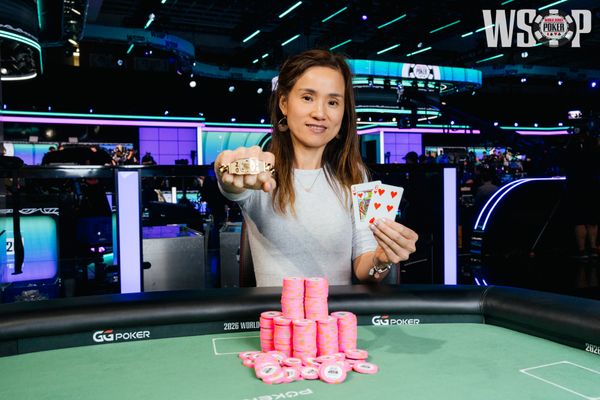
Yanting Jiang proved that table talk isn’t everything in poker, capturing her first WSOP bracelet and $1.16 million in the $3,000 Mid-Stakes Championship. The Florida-based cash game specialist outlasted 3,668 entries and a star-studded final table without relying on speech play, letting her strategic decisions do all the talking.
What Happened
The $3,000 Mid-Stakes Championship at the World Series of Poker delivered a marathon final table that stretched nearly six hours before claiming its first casualty. Jiang entered the final nine alongside a formidable lineup that included Triton Tour regular Punnat Punsri, 25-time Circuit ring winner Maurice Hawkins, British veteran Roberto Romanello, and several accomplished American pros.
The tournament structure featured 60-minute levels, creating a slow-burn environment where patience and precision mattered more than aggressive fireworks. After the field whittled down from 16 players to the final table relatively quickly, the action became a war of attrition. Short stacks found crucial doubles, blinds climbed steadily, and the pressure mounted with each passing orbit.
Punsri, who had been struggling throughout this year’s WSOP despite his GPI Player of the Year credentials, busted in 6th place for $250,110. Hawkins, known for his constant table chatter and remarkable comeback from a single small blind, fell in 4th for $432,875—still searching for that elusive first WSOP bracelet to complement his impressive Circuit ring collection.
Jiang navigated through Yoon Choi in third place before facing Chahn Jung heads-up. When the final cards fell, she had conquered the entire field, becoming the fourth woman to claim gold at the 2026 WSOP alongside Kristen Foxen, Michelle Chin, and Skye Chen. Jung took home $772,580 for second place, while Jiang’s victory marked a career-defining moment for someone primarily known for cash game play.
The Poker Strategy Breakdown
Jiang’s approach at this final table offers a masterclass in disciplined tournament poker. While Hawkins maintained his characteristic running commentary and attempted to engage opponents verbally, Jiang remained largely silent—not as a strategic choice necessarily, but because English isn’t her first language. This apparent disadvantage became an unexpected strength.
Without the ability to engage in traditional speech play, Jiang was forced to rely entirely on fundamental poker strategy: hand selection, position awareness, bet sizing, and reading betting patterns rather than verbal tells. This stripped-down approach eliminated the noise that can sometimes cloud judgment at high-pressure final tables.
The structure of this Championship event—with its deep stacks and lengthy levels—rewarded patient, mathematically sound play over flashy moves. Jiang demonstrated excellent ICM awareness throughout, understanding when to apply pressure and when to fold marginal holdings. Her ability to find timely doubles when short and avoid unnecessary confrontations when comfortable showcased tournament maturity that belied her limited recorded results.
One critical element of Jiang’s success was her adaptability to changing stack dynamics. As Hawkins mounted his improbable comeback from a single small blind, the table dynamics shifted dramatically. Players who had been comfortable suddenly faced a resurgent threat, and the ICM pressure intensified. Jiang navigated these shifts without panicking or deviating from solid fundamentals.
Her heads-up play against Jung demonstrated a complete game. Heads-up poker requires aggression, but controlled aggression backed by sound ranging and hand reading. The ability to apply pressure without spewing chips, and to make disciplined folds when behind, separates champions from runners-up. Jiang clearly possessed this balance.
Reading The Field & Table Dynamics
The final table composition created fascinating strategic dynamics. With six Americans, a British pro, a Greek player, and competitors from Thailand and China, the table represented a true international poker melting pot. Different playing styles, cultural approaches to the game, and varying levels of aggression all influenced the flow of play.
Hawkins’ verbal dominance at the table—calling Jiang a “wild card”—might have been intended to put her on tilt or extract information. For many players, being labeled unpredictable could trigger either overly tight play (to prove they’re not wild) or reckless aggression (to live up to the label). Jiang did neither. She simply continued executing her game plan.
This highlights an important tournament concept: your table image matters less than your actual decisions. While Hawkins tried to categorize Jiang’s play style, she wasn’t concerned with managing perceptions—only with making optimal decisions based on stack sizes, position, and ranges.
The presence of high-stakes regular Punsri and the accomplished Romanello meant Jiang couldn’t rely on opponent mistakes alone. These players understand advanced concepts like minimum defense frequency, balanced ranges, and exploitative adjustments. Beating them required A-game execution, not just waiting for errors.
The marathon nature of the final table also tested mental stamina. Six hours to eliminate the first player means maintaining focus through countless hands where you’re folding preflop or on the flop. The ability to stay alert and avoid mental fatigue becomes as important as technical skill. Jiang’s composed performance—especially impressive considering she’d celebrated her birthday the day before—demonstrated the mental fortitude required for deep tournament runs.
How To Apply This To Your Game
Jiang’s victory offers several actionable lessons for players at all levels. First, don’t overestimate the importance of table talk. While speech play can be a useful tool in your arsenal, it’s far from essential. Many players—especially those new to live poker—feel pressured to engage verbally with opponents. Jiang’s win proves you can succeed by focusing purely on strategic fundamentals.
Second, embrace your natural style rather than forcing yourself into uncomfortable territory. Jiang is primarily a cash game player with limited tournament experience. Rather than trying to emulate tournament specialists, she applied her cash game skills—hand reading, mathematical decision-making, and disciplined bankroll management—to the tournament format. Identify your strengths and build your strategy around them.
Third, understand that tournament poker rewards patience more than most players realize. The temptation to force action, especially at final tables, can be overwhelming. But with 60-minute levels and deep stacks, there’s no need to gamble unnecessarily. Wait for premium spots, apply pressure when you have leverage, and avoid marginal situations where you’re risking tournament life without clear equity advantages.
Fourth, study ICM dynamics relentlessly. The difference between 4th place ($432K) and 1st place ($1.16M) in this event was over $700K—life-changing money. Understanding when ICM pressure should make you tighter and when it allows you to apply pressure on opponents is crucial for maximizing your tournament ROI.
Finally, work on your mental game and stamina. The ability to maintain focus during long sessions, especially after the adrenaline of reaching a final table wears off, separates consistent winners from players who flame out. Develop routines that help you stay sharp: proper nutrition, hydration, brief mental resets between hands, and breathing exercises to manage stress.
Key Takeaways
- Table talk and speech play are overrated—solid fundamentals and strategic decision-making matter far more than verbal jousting at the table
- Deep-stacked tournament structures reward patience and mathematical precision over aggressive fireworks and fancy plays
- ICM awareness becomes increasingly critical as final tables progress, especially when pay jumps grow larger between positions
- Mental stamina and focus over marathon sessions can be as important as technical poker skill when competing at championship levels
- Cash game skills translate effectively to tournament play when combined with proper stack management and stage-appropriate aggression
- Your perceived table image matters less than the actual quality of your decisions—don’t let opponents’ labels influence your strategy
Frequently Asked Questions
How important is table talk in modern tournament poker?
While table talk can provide information and potentially put opponents on tilt, it’s far from essential for success. Yanting Jiang’s victory demonstrates that strong fundamentals, mathematical decision-making, and disciplined play matter more than verbal engagement. Many top players succeed without extensive speech play, focusing instead on reading betting patterns, managing ranges, and making optimal decisions based on position and stack dynamics.
What makes the Mid-Stakes Championship structure different from typical WSOP events?
The $3,000 Mid-Stakes Championship features 60-minute levels rather than the standard 60-minute or shorter structures seen in many WSOP events. This creates a deeper-stacked environment where patience is rewarded and players have more room to maneuver. The longer levels reduce variance somewhat and emphasize skill over luck, as players have more time to accumulate chips through strategic play rather than relying on a few critical all-in situations.
How can cash game players transition successfully to tournament poker?
Cash game players possess many skills that translate well to tournaments: hand reading, mathematical decision-making, and emotional control. The key adjustments involve understanding ICM pressure, adapting to changing stack depths, and recognizing that chip accumulation matters differently than in cash games. Focus on studying tournament-specific concepts like bubble dynamics, final table ICM, and stage-appropriate aggression while leveraging your existing strengths in hand analysis and opponent profiling.
Final Thoughts
Yanting Jiang’s breakthrough WSOP victory challenges conventional wisdom about what it takes to succeed in elite tournament poker. While many players obsess over table presence, speech play, and cultivating intimidating images, Jiang demonstrated that excellence in fundamental strategy trumps all the verbal fireworks and psychological warfare.
Her win is particularly impressive given the caliber of opposition at the final table. Defeating accomplished professionals like Maurice Hawkins and Punnat Punsri—players with decades of combined experience and countless titles—requires more than luck. It demands precision in hand selection, discipline in marginal spots, and the mental fortitude to execute your strategy under immense pressure.
For aspiring tournament players, Jiang’s success offers an encouraging blueprint: master the fundamentals, understand ICM dynamics, maintain emotional control, and trust your strategic process. You don’t need to be the loudest voice at the table or the most intimidating presence. You simply need to make better decisions than your opponents over a large enough sample of hands. Sometimes, the quietest player in the room has the most powerful game.
Ready to Sharpen Your Poker Game?
Master your poker game with expert hand analysis