

How Matthew Blagg Won His First WSOPC Ring in Vegas
Matthew Blagg turned a below-starting-stack dinner break into a $238,470 payday and his maiden WSOP Circuit ring, conquering a massive 936-player field at Horseshoe Las Vegas. The previously ringless grinder leveraged his online tournament experience to navigate a treacherous final table and claim the biggest victory of his poker career.
What Happened
The WSOPC Horseshoe Las Vegas Main Event attracted 936 runners for a $1,298,780 prize pool, with 107 players cashing. Blagg entered the final table sitting fourth in chips with 4.5 million, trailing chip leader Eric Yanovsky who had been accumulating relentlessly throughout Day 2.
The final table saw aggressive action from the opening hands. Chinese pro Jingyang He doubled through Philip Lucia with pocket kings versus queens on just the second hand, then eliminated Lucia in ninth for $18,860 shortly after. But He’s momentum reversed when Blagg called his four-million-chip shove with pocket kings, only to discover He held pocket jacks. The cowboys held, propelling Blagg into second position.
The pivotal hand came during four-handed play when Yanovsky, still commanding the chip lead, moved all in for over five million effective chips. Blagg woke up with pocket aces and called, scoring a massive double to draw nearly even at the top. However, the very next hand saw Yanovsky reclaim those chips by eliminating Jia Chi Li in fourth place ($79,920) when his kings held against Li’s sixes.
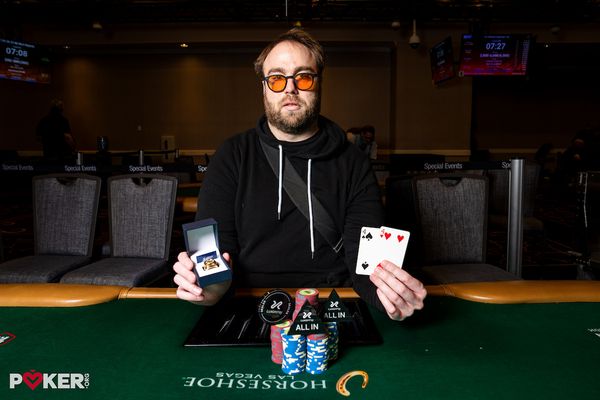
Blagg regrouped during three-handed play, shoving successfully through Yanovsky on the turn to rebuild his stack. He then eliminated Daniel Lei in third place for $111,880, taking the chip lead into heads-up play against Yanovsky. After nearly eight hours of final table combat, Blagg secured the victory, the ring, and $238,470—more than doubling his lifetime tournament earnings to $447,035.
The Poker Strategy Breakdown
Blagg’s victory showcased several crucial tournament concepts that separate winners from also-rans. His most spectacular hand came on Day 1B during his comeback run—a four-way all-in preflop where he held ace-king against three premium pairs: kings, queens, and jacks. The board delivered four hearts with Blagg holding the ace of hearts, eliminating two opponents and rocketing him to near the chip lead with 1.2 million.
While this hand involved significant variance, Blagg’s willingness to get his stack in with ace-king in a multiway pot demonstrates proper tournament aggression. With his tournament life on the line and holding a hand that plays well against multiple ranges, the equity realization against three opponents made the spot profitable in the long run, even if dominated by one hand.
The kings versus jacks confrontation during final table play reveals another layer of Blagg’s strategic approach. Facing a near-four-million-chip shove from He with the big blind at 120,000 and four shorter stacks remaining, Blagg made the call with pocket jacks. This decision factors in several elements: stack sizes relative to blinds, the presence of multiple short stacks creating pay jump pressure on opponents, and range construction for an opponent willing to risk tournament life with significant stacks behind.
Blagg’s comment about the situation—”I mean, I’m not gonna fold everything”—reflects a sophisticated understanding of final table dynamics. He recognized that tightening up excessively would allow opponents to run over him, and that defending his stack required calculated gambles at opportune moments.
The crucial pocket aces hand against Yanovsky during four-handed play exemplifies patience meeting opportunity. Rather than forcing action, Blagg waited for premium holdings to confront the chip leader’s aggression. This disciplined approach allowed him to double through in a dominant position rather than gambling in marginal spots.
Reading The Field & Table Dynamics
Blagg’s mental game approach proved equally important as his technical execution. Drawing on his extensive online tournament experience—”I have been through this process like a 1,000+ times online”—he reframed the live final table pressure as familiar territory. This psychological framework allowed him to execute his strategy without the anxiety that often plagues less experienced live players.
His observation about early final table action reveals sharp ICM awareness: “Not to be too Inside Baseball, but that is generally good if people want to bust. The pay jumps aren’t huge at that point.” This recognition that other players’ aggression created opportunities rather than threats shows mature tournament thinking. When opponents overplay their hands trying to accumulate, patient players with strong ranges benefit enormously.
Blagg specifically noted appreciating “some wild cards at the table kinda gambling,” understanding that variance-seeking opponents provide profit opportunities for disciplined players. This dynamic became especially valuable given his 100-big-blind stack entering Day 2—deep enough to play solid poker but not so deep that he could afford to pass up profitable spots.
The heads-up battle against Yanovsky presented a different challenge entirely. Blagg acknowledged his opponent’s skill level candidly: “I knew he was very good, and I don’t know who is better between me or him.” This honest assessment led to a strategy focused on mistake avoidance rather than hero plays—a mature approach that many players struggle to implement when ego enters the equation.
Interestingly, Blagg admitted to one strategic oversight: forgetting that live tournament antes in heads-up play equal the big blind, whereas online they’re significantly smaller. This detail affects optimal shoving and calling ranges substantially, making heads-up play more aggressive than online formats. His ability to adapt despite this knowledge gap demonstrates strong fundamental understanding and hand-reading skills that transcend specific ante structures.
How To Apply This To Your Game
Blagg’s victory offers several actionable lessons for tournament players at all levels. First, leverage your existing experience to manage pressure. If you’ve played thousands of hands online, recognize that live poker involves the same fundamental decisions with the added element of physical tells. This reframing can reduce anxiety and improve decision-making quality.
Second, understand that tournament comebacks require sustained aggression at the right moments. Blagg went from below starting stack at dinner break to second in chips by end of Day 1 by capitalizing on opportunities. This doesn’t mean reckless gambling—it means identifying spots where your equity justifies risk and pulling the trigger decisively.
Third, adjust your strategy based on opponent tendencies rather than rigid formulas. When Blagg recognized players willing to gamble at the final table, he widened his calling ranges appropriately. Conversely, against a skilled heads-up opponent, he tightened his focus to mistake minimization. This adaptive approach beats one-size-fits-all strategies every time.
Fourth, pay attention to structural details that affect optimal play. Ante structures, payout jumps, and stack distributions all influence correct strategy. While Blagg momentarily forgot about heads-up ante sizing, his recognition of pay jump dynamics earlier in the final table created profitable opportunities.
Finally, maintain realistic self-assessment. Blagg’s acknowledgment that he couldn’t definitively claim superiority over Yanovsky kept him focused on solid execution rather than outplaying his opponent. This mindset prevents the costly mistakes that often occur when players try to prove they’re better rather than simply making optimal decisions.
Key Takeaways
- Online experience translates: Blagg’s 1,000+ online final tables provided the mental framework to handle live tournament pressure and execute his strategy without anxiety.
- Aggression requires timing: The comeback from below starting stack to chip contender came from identifying profitable spots for aggression, not reckless gambling.
- ICM awareness creates edges: Understanding that small pay jumps early at final tables reduce folding incentives allowed Blagg to call wider against aggressive opponents.
- Adapt to opponent types: Against gamblers, widen value ranges; against skilled opponents, focus on mistake avoidance rather than hero plays.
- Premium hands win big pots: The crucial double with aces against the chip leader exemplifies patience meeting opportunity—waiting for strong holdings to confront aggression.
- Mental game matters: Reframing live pressure as familiar online scenarios and maintaining honest self-assessment prevented costly emotional mistakes.
Frequently Asked Questions
How did Matthew Blagg overcome starting the final table in fourth chip position?
Blagg combined patience with calculated aggression, waiting for premium holdings like pocket kings and aces to confront opponents’ aggression. He recognized that other players’ willingness to gamble created opportunities, and he capitalized by calling with strong ranges when the math supported it. His crucial double with aces against chip leader Eric Yanovsky during four-handed play vaulted him into contention, and he maintained momentum through to heads-up play.
What was the most important hand in Blagg’s victory?
While the four-way all-in on Day 1B with ace-king against three premium pairs was spectacular, the most strategically important hand was likely his pocket aces versus Yanovsky’s shove during four-handed play. This hand doubled him to nearly even in chips with the dominant chip leader and shifted momentum heading into three-handed play. It exemplified patience meeting opportunity—waiting for premium holdings rather than forcing action in marginal spots.
How can recreational players apply Blagg’s approach to smaller buy-in tournaments?
Focus on three key elements from Blagg’s playbook: First, leverage whatever experience you have (even if it’s online micro-stakes) to manage pressure by recognizing familiar decision points. Second, pay attention to opponent tendencies and adjust your ranges accordingly—tighten against tight players, widen against gamblers. Third, understand pay jump dynamics at your final table and recognize when small pay jumps mean you can profitably call wider against aggressive opponents. These concepts scale to any buy-in level.
Final Thoughts
Matthew Blagg’s maiden Circuit ring victory demonstrates that tournament success stems from combining solid fundamentals with adaptive strategy and strong mental game. His ability to translate online experience into live results, recognize opponent tendencies, and execute disciplined aggression at crucial moments separated him from a field of nearly 1,000 players.
Perhaps most instructive is Blagg’s honest self-assessment and focus on process over ego. Rather than trying to outplay skilled opponents like Yanovsky, he concentrated on making optimal decisions and avoiding costly mistakes. This approach—combined with the patience to wait for premium holdings and the courage to get his stack in when the math supported it—proved to be the winning formula.
For players looking to improve their tournament results, Blagg’s victory offers a roadmap: build experience (online or live), study ICM and pay jump dynamics, develop opponent awareness, and maintain the mental discipline to execute your strategy under pressure. The cards will take care of themselves when your decision-making process is sound.
Ready to Sharpen Your Poker Game?
Master your poker game with expert hand analysis
