GGPoker’s $1M Spin & Gold Hits Three Times in 72 Hours
Lightning struck three times in a single week at GGPoker as the site’s $1 million Spin & Gold jackpot triggered on three separate occasions between March 8-10. The unprecedented cluster of maximum multiplier hits created five new six-figure winners and distributed $3 million in prizes across just 72 hours.
What Happened
GGPoker’s Spin & Gold format follows the familiar jackpot sit-and-go structure: three players enter, a randomized prize multiplier determines the pool, and winner-takes-most. While smaller multipliers hit regularly, the 20,000x maximum multiplier that creates the $1 million prize pool is designed to be extraordinarily rare.
That rarity made the events of early March all the more remarkable. The first jackpot triggered on Sunday, March 8, when three players sat down to a $50 buy-in table. When the spinner stopped, each player was guaranteed at least $200,000, with ‘Justmyflower’ ultimately claiming the $500,000 first-place prize.
Just 48 hours later, the poker gods smiled twice more. Player ‘rcdanielllll’ turned a $10 entry into $500,000, while ‘Borisz Bulgakov’ scored an identical half-million payday from a $200 buy-in on the same day. The March 10 double-hit marked only the second and third times the maximum multiplier had appeared that month, following a $10 jackpot on March 3 and a $200 tournament spike on February 19.
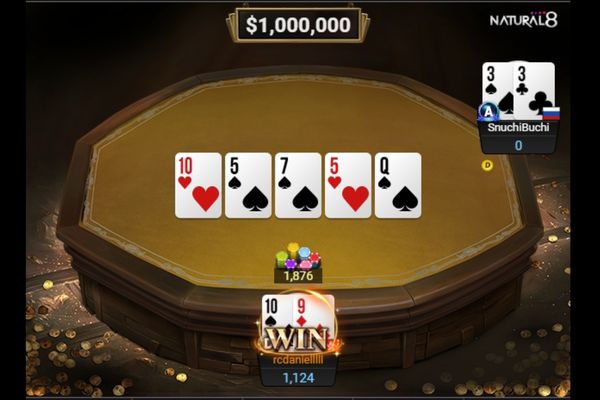
The most dramatic finish came in the $10 tournament. With blinds at 30/60 and nearly identical chip stacks, ‘SnuchiBuchi’ moved all-in holding ace-nine offsuit. ‘rcdanielllll’ made a gutsy call with king-jack suited, flopped top pair, and held to secure the win. That single decision represented a $200,000 swing between first and second place.
The Poker Strategy Breakdown
The king-jack versus ace-nine confrontation in the $10 jackpot deserves closer examination because it illustrates how dramatically strategy shifts when life-changing money appears on the table. In a standard $10 hyper-turbo, calling off your stack with KJs in a heads-up situation against an aggressive opponent is often correct. You’re roughly 40% against most shoving ranges, and the tournament equity makes it a clear call.
But when $500,000 sits at the top and $300,000 for second place, the ICM pressure becomes suffocating. The $200,000 difference between first and second represents 40% of the total prize pool, yet both players held approximately 50% of the chips. This creates a fascinating dynamic where the chip leader should actually play more conservatively than in a normal tournament, while the short stack gains fold equity from the leader’s reluctance to risk elimination.
In this specific hand, ‘SnuchiBuchi’ made a reasonable shove with A9o. Against a tight range, it performs well, and the fold equity alone makes it profitable in most scenarios. The ace blocks premium holdings, and nine-high has decent equity against the lower Broadway combinations and pocket pairs an opponent might call with.
‘rcdanielllll’s call with KJs is where the decision becomes genuinely interesting. King-jack suited is ahead of approximately 35-40% of reasonable shoving ranges, behind roughly 50%, and flipping with the remainder. In a vacuum, this is borderline at best. However, several factors justify the call: the near-even stacks mean ICM pressure applies equally to both players, the opponent’s shoving range likely includes hands KJs dominates or flips with, and the suited aspect provides additional equity through flush possibilities.
The flop brought a king, giving ‘rcdanielllll’ top pair and leaving ‘SnuchiBuchi’ drawing to three aces or a gutshot straight. With only five outs twice, the ace-nine was roughly 11% to win. The hand demonstrates how even when millions are on the line, fundamental poker mathematics still govern outcomes. The better equity prevailed, as it does over time, regardless of the stakes involved.
Reading The Field & Table Dynamics
Spin & Gold tournaments present unique psychological challenges that separate them from standard tournament poker. The moment that spinner stops on the maximum multiplier, every player at the table experiences an instant mental shift. You’ve gone from playing for what amounts to beer money to competing for a sum that could change your financial life permanently.
This psychological shock affects players differently. Some tighten up dramatically, hoping to secure the minimum cash. Others recognize that the pay jumps are so massive that only first place truly matters and begin playing hyper-aggressively. The optimal strategy lies somewhere between these extremes and depends heavily on your opponents’ visible adjustments.
When the $1 million prize pool hits, you’re guaranteed $200,000 for third, $300,000 for second, and $500,000 for first. The ICM implications are severe. With three players remaining and relatively even stacks, each elimination dramatically increases your equity in the remaining prize pool. This means that in multi-way pots, you should play even more cautiously than heads-up, as getting caught in the middle can be catastrophic.
The starting stack depth in these tournaments matters enormously. Most Spin & Gold variants begin with 500 chips and 25/50 blinds, giving you just 10 big blinds. This hyper-turbo structure means you’ll often be in push-fold mode from the first hand. When the jackpot hits, this shallow structure actually helps manage the psychological pressure because your strategic options are limited. You don’t have room for fancy plays or elaborate bluffs—just solid push-fold mathematics.
Observing how your opponents react to the big multiplier provides crucial information. If both opponents immediately tighten up, you can exploit this by increasing your aggression, stealing blinds, and building a stack that gives you leverage in later confrontations. Conversely, if you notice an opponent going into gamble mode, making loose calls and wild shoves, you should tighten your range and wait for premium holdings to trap them.
How To Apply This To Your Game
Most players will never experience a $1 million Spin & Gold jackpot—the odds are simply too long. However, the strategic principles these tournaments highlight apply to countless poker situations where the money suddenly becomes significant relative to your bankroll.
First, develop a clear understanding of push-fold charts for short-stacked play. In hyper-turbo formats, you’ll frequently face decisions with 10 big blinds or fewer. Knowing which hands to shove from each position and which hands to call with is fundamental. Many players rely on intuition in these spots and make costly errors. Study Nash equilibrium charts and practice applying them until the correct plays become automatic.
Second, recognize when ICM considerations should override chip equity. In the $10 jackpot hand, both players held roughly equal chips, but the prize structure meant that doubling up only increased your equity by $200,000 while busting out cost you $300,000. This asymmetry means you should fold some hands that would be clear calls in a chip-EV situation. Understanding when to make these ICM-based folds separates good tournament players from great ones.
Third, practice emotional regulation for high-pressure situations. The players who won these jackpots had to make clear decisions while processing the reality of life-changing money on the line. You can develop this skill by properly bankrolling yourself for the stakes you play. If every tournament represents a significant portion of your bankroll, you’ll never develop the emotional equilibrium needed for optimal decision-making. Play within your means so that even your biggest tournaments don’t cloud your judgment.
Fourth, study your opponents’ tendencies under pressure. In regular Spin & Gold tournaments at lower multipliers, take notes on how different players react when the prize pool jumps significantly. Some players consistently tighten up, others get more aggressive, and a few maintain their baseline strategy. These patterns will help you exploit them if you ever find yourself in a jackpot situation together.
Finally, don’t let the dream of a massive score distract you from the fundamentals. The players who won these jackpots didn’t employ secret strategies or make miraculous plays. They executed solid short-stack poker, made mathematically sound decisions, and got a bit lucky when it mattered. Focus on making correct decisions consistently, and the results will take care of themselves over time.
Key Takeaways
- GGPoker’s $1 million Spin & Gold jackpot hit three times in 72 hours during March 8-10, creating five six-figure winners and distributing $3 million in prizes
- The maximum multiplier triggered at $50, $10, and $200 buy-in levels, with first-place prizes of $500,000 in each tournament
- ICM pressure in jackpot situations dramatically changes optimal strategy, often making you fold hands that would be clear calls in chip-EV scenarios
- Short-stack push-fold mathematics remain fundamental regardless of prize pool size—study Nash equilibrium charts and apply them consistently
- Psychological preparation and emotional regulation are crucial skills for handling high-pressure situations when significant money appears unexpectedly
- The $1 million jackpot has hit at least five times in 2026, suggesting GGPoker’s frequency settings may be more generous than competitors
Frequently Asked Questions
What are the odds of hitting the $1 million jackpot in GGPoker Spin & Gold?
GGPoker doesn’t publicly disclose the exact probability of hitting the maximum multiplier, but based on industry standards for jackpot sit-and-gos, the odds are typically between 1 in 1,000,000 and 1 in 10,000,000 depending on the buy-in level. Higher buy-in tournaments generally have slightly better odds of hitting the top multiplier. The fact that the jackpot hit five times in just over a month during early 2026 suggests either an unusually lucky streak or potentially more favorable odds than competitors offer.
How should I adjust my strategy when the maximum multiplier hits?
When the jackpot triggers, your strategy should shift based on ICM considerations rather than pure chip equity. With the extreme pay jumps in $1 million prize pools, survival becomes more valuable than chip accumulation in the early stages. Tighten your calling ranges, avoid marginal spots where you could bust, and be patient for premium holdings. However, don’t play so tight that you blind off—you still need to accumulate chips to have any chance at first place. The key is finding the balance between preservation and aggression based on your opponents’ adjustments and your relative stack size.
What buy-in levels offer Spin & Gold tournaments at GGPoker?
GGPoker offers Spin & Gold tournaments at buy-ins ranging from $0.25 to $200. Each buy-in level has its own prize structure and multiplier distribution, with the $1 million maximum prize pool available at higher stakes. Lower buy-in tournaments typically offer smaller maximum multipliers, while the $50, $100, and $200 levels all have access to the top jackpot. The variety of stakes makes the format accessible to players with different bankrolls while still offering everyone a chance at life-changing prizes.
Final Thoughts
The cluster of $1 million jackpots at GGPoker during early March 2026 represents a statistical anomaly that captured the imagination of the poker community. For the five players who found themselves competing for half a million dollars after buying in for as little as $10, the experience undoubtedly provided both the thrill of a lifetime and an intense test of their poker skills under extreme pressure.
What makes these stories compelling isn’t just the money involved, but the reminder that poker remains a game where anyone can compete for life-changing prizes. The player who turned $10 into $500,000 didn’t need to satellite through multiple tournaments, accumulate years of experience, or possess a massive bankroll. They simply needed to register for a tournament, get extraordinarily lucky with the multiplier, and then execute solid fundamentals when it mattered most.
For the rest of us grinding away at more modest stakes, these jackpot stories serve as both inspiration and cautionary tale. They’re inspiring because they demonstrate that massive scores remain possible even at micro-stakes. They’re cautionary because chasing jackpots without proper bankroll management and solid fundamental strategy is a recipe for disappointment. The winners didn’t just get lucky with the spinner—they made correct decisions when the pressure was highest. That combination of opportunity and execution is what separates poker from pure gambling, and it’s what makes the game endlessly fascinating regardless of the stakes involved.
Ready to Sharpen Your Poker Game?
Master your poker game with expert hand analysis