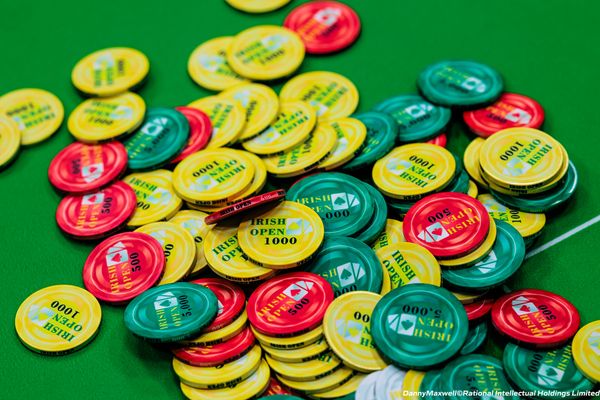
Irish Open Shatters Records: 5,003 Players Battle in Dublin
The Irish Poker Open has rewritten the history books once again, drawing an unprecedented 5,003 entries to its Main Event and generating a prize pool exceeding €4.8 million. With representatives from 86 nations descending on Dublin’s Royal Dublin Society, the tournament has solidified its position as Europe’s must-play poker destination—and the strategic implications of navigating such a massive field offer critical lessons for tournament players at every level.
What Happened
When late registration closed on the final Day 1 flight, tournament organizers confirmed what many suspected would be another banner year for Ireland’s flagship poker event. The 5,003-entry field represents a nearly 10% increase over 2025’s previous record of 4,562 runners, won by Irish player Simon Wilson.
The massive turnout across five starting flights generated a prize pool of €4,852,910—more than doubling the guaranteed amount and creating a top-heavy payout structure that will reward deep runs handsomely. Of the original field, just 1,236 players bagged chips to advance to Day 2, representing a survival rate of approximately 24.7%.
Sweden’s Kristian Svanbom emerged as the chip leader heading into Day 2 with 899,000 chips, followed by the UK’s Lawrence Penfold (796,000) and Italy’s Massimiliano Cordeschi (773,000). The surviving field includes a who’s who of poker talent, with 888poker Ambassador Ian Simpson (554,000), Will Kassouf (468,000), and ACR Team Online member Conor O’Driscoll (391,000) all holding healthy stacks.
Defending champion Simon Wilson remains in contention with 261,000, while other notable survivors include high-stakes crusher Stephen O’Dwyer (275,000), content creator Parker Talbot (187,000), and veteran Barny Boatman (200,000). Day 2 action resumed at noon local time with blinds at 3,000/6,000 and a 6,000 big blind ante.
The Poker Strategy Breakdown
Tournaments of this magnitude present unique strategic challenges that differ substantially from smaller-field events. With over 5,000 entries, the Irish Open Main Event creates a mathematical reality that fundamentally alters optimal play throughout the tournament’s various stages.
First, consider the survival dynamics. With only 24.7% of the field advancing to Day 2, Day 1 flights become exercises in controlled aggression balanced against preservation. The sheer number of recreational players in a field this size—drawn by the prestige of the Irish Open brand—creates exploitable situations, but also introduces significant variance through unpredictable play patterns.
The chip distribution heading into Day 2 reveals telling information about optimal accumulation strategies. Svanbom’s 899,000 chip stack represents approximately 150 big blinds at the Day 2 restart—a commanding position, but not insurmountable given the tournament’s structure. More importantly, the gap between the chip leader and players in the 300,000-400,000 range (approximately 50-65 big blinds) isn’t catastrophic. This suggests that steady accumulation throughout Day 1, rather than high-variance gambles for chip leadership, remains a viable path forward.
The international composition of the field—86 countries represented—also impacts strategic considerations. Different poker cultures approach tournament play with varying risk tolerances and strategic frameworks. European players often employ tighter ranges in early positions compared to their North American counterparts, while players from emerging poker markets may display wider variance in skill levels and strategic sophistication.
For the professionals still in contention, the presence of so many recreational players creates both opportunity and danger. While weaker opponents provide clear +EV spots, their unpredictability makes hand reading more challenging and increases the likelihood of bad beats that can cripple even the most skilled players’ tournament lives.
Reading The Field & Table Dynamics
As Day 2 progresses, understanding field dynamics becomes paramount to tournament success. With 1,236 players remaining and only the top 15-20% likely to cash, the bubble phase will create dramatic shifts in optimal strategy.
The presence of big-name professionals throughout the chip counts creates interesting table dynamic scenarios. Drawing a table with multiple recognizable pros requires adjusting your strategy—these players will be more difficult to bluff, more likely to recognize your betting patterns, and generally more capable of making thin value bets and hero calls.
Conversely, recreational players who survived Day 1 often display specific tendencies that sharp players can exploit. Many will tighten up considerably on Day 2, having “made it” to the second day and now playing scared money. This creates opportunities for aggressive players to accumulate chips through well-timed steals and three-bets, particularly as the bubble approaches.
ICM considerations don’t become critical until later stages, but understanding pay jump implications helps inform marginal decisions. In a field this large, the difference between min-cashing and making a deep run is substantial—both in terms of prize money and the prestige associated with final tabling a record-breaking Irish Open.
Stack sizes relative to the average become increasingly important as Day 2 progresses. Players with 20-30 big blinds enter the danger zone where they’re too short to apply maximum pressure but too deep to simply push-or-fold. This awkward stack size requires careful hand selection and acute awareness of position and opponent tendencies.
The chip leaders, meanwhile, can leverage their stacks to apply maximum pressure, but must guard against spewing chips in marginal spots. With so many players still in contention, there’s no need for big stacks to gamble unnecessarily—the natural attrition rate will improve their position without taking high-variance lines.
How To Apply This To Your Game
The strategic lessons from massive-field tournaments like the Irish Open translate directly to your own tournament play, regardless of buy-in level. Here’s how to implement these concepts:
Adjust Your Day 1 Strategy: In large-field events, survival with a playable stack often trumps high-risk chip accumulation. Focus on exploiting obvious mistakes from recreational players rather than getting involved in marginal spots against competent opponents. Your goal should be reaching Day 2 with 30+ big blinds, not necessarily bagging the chip lead.
Recognize Field Composition: Pay attention to the mix of recreational and professional players at your table. Against weaker opponents, widen your value-betting ranges and narrow your bluffing frequencies—they’ll call too often and fold too rarely. Against stronger players, balance becomes more important and creative lines more valuable.
Manage Your Stack Zones: Understand the strategic implications of your stack size relative to the blinds. With 50+ big blinds, you can play a fuller range and apply pressure. Between 20-40 big blinds, tighten up and focus on quality over quantity. Below 20 big blinds, identify profitable reshove spots and don’t wait for premium hands that may never come.
Study Bubble Dynamics: The approach to the money bubble creates the most dramatic strategic shift in any tournament. Practice applying pressure to medium stacks who are trying to ladder up, while avoiding unnecessary confrontations with short stacks looking to double or go home.
Maintain Emotional Discipline: In fields this large, you’ll experience brutal bad beats and unlikely runouts. The key is maintaining strategic discipline regardless of short-term results. Every decision should be evaluated based on long-term expectation, not outcome-oriented thinking about individual hands.
Key Takeaways
- The Irish Open’s record 5,003-entry field demonstrates the growing global appeal of European tournament poker and creates unique strategic challenges for players at all skill levels
- Only 24.7% of the field survived to Day 2, emphasizing the importance of balanced aggression and survival-oriented play in massive-field events
- The international composition (86 countries) requires adapting to diverse playing styles and varying levels of strategic sophistication
- Chip accumulation strategy should prioritize steady growth over high-variance gambles, as evidenced by the relatively compressed chip distribution among Day 2 survivors
- Understanding stack zones and ICM implications becomes increasingly critical as the tournament progresses toward the money bubble and final table
- Professional players must balance exploiting recreational opponents while managing the increased variance that unpredictable play introduces
Frequently Asked Questions
How does strategy change in massive-field tournaments compared to smaller events?
In large-field tournaments like the Irish Open, you’ll encounter a wider skill range and more recreational players, which calls for more straightforward value-betting and less fancy play. The extended structure and multiple Day 1 flights also mean you can afford to be more patient and selective with your spots, as survival with a workable stack is often more valuable than high-risk chip accumulation. Additionally, the longer path to the final table means preserving your stack through the early stages takes priority over immediate chip leadership.
What stack size should you target when bagging chips on Day 1?
Ideally, you want to finish Day 1 with at least 30-40 big blinds relative to where Day 2 will restart. This gives you enough flexibility to play poker without being in push-fold mode, while also providing a cushion against the natural blind increases. In the Irish Open, players bagging around 200,000-300,000 chips had approximately 33-50 big blinds for the Day 2 restart at 3,000/6,000, which represents a healthy position for continued deep-run potential without requiring desperate measures.
How should you adjust your play when seated with multiple professional players?
When sharing a table with several recognizable pros, tighten your opening ranges slightly and be more selective with your bluffs. These players will be more observant of your patterns and more capable of making exploitative adjustments, so you need to maintain better balance in your play. Focus on position-based aggression rather than creative lines, and don’t be afraid to take smaller pots uncontested rather than getting involved in large pots with marginal holdings. Save your bluffs for spots where your story makes sense and you’ve established a tight image.
Final Thoughts
The Irish Open’s record-breaking field represents more than just impressive numbers—it’s a testament to tournament poker’s enduring appeal and the strategic depth that keeps players coming back year after year. For the 1,236 survivors advancing to Day 2, the real work has just begun. The path from here to the final table requires navigating complex ICM situations, managing stack sizes through multiple pay jumps, and maintaining strategic discipline through the inevitable swings of tournament poker.
What makes events like this so valuable for serious players isn’t just the prize pool, but the concentrated experience they provide. Playing through a field this large, with this much international diversity, accelerates your strategic development in ways that smaller events simply cannot match. Every table presents new challenges, every level requires fresh adjustments, and every decision carries magnified consequences given the stakes involved.
Whether you’re a recreational player dreaming of your own Irish Open deep run or a serious grinder looking to sharpen your tournament game, the strategic principles on display in Dublin apply universally. Study how the best players navigate these massive fields, understand the mathematical realities that drive optimal decision-making, and most importantly, continue refining your game through deliberate practice and analysis.
Ready to Sharpen Your Poker Game?
Master your poker game with expert hand analysis