Kristen Foxen’s Masterclass in Exploiting Tilted Opponents
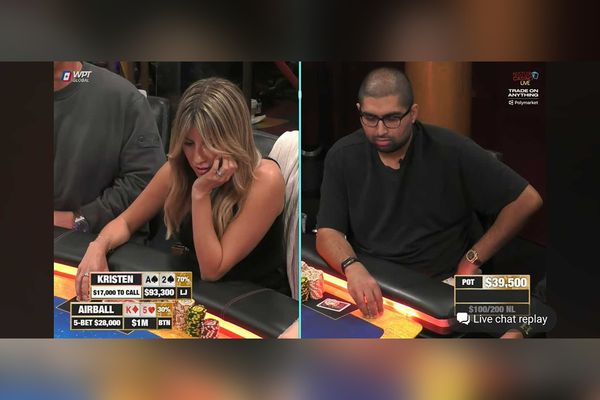
When Kristen Foxen six-bet shoved trash against Nik Airball’s relentless aggression on Hustler Casino Live, she wasn’t just making a play—she was executing a textbook exploitation of a tilting opponent. The hand, played at $100/$200 blinds with nearly $400K on the line, demonstrates why understanding your opponent’s mental state matters more than your actual cards.
What Happened
The stage was set for fireworks at Hustler Casino Live during a recent nosebleed cash game session. The lineup featured an intriguing mix of recreational players and professionals, including Ethan “Rampage” Yau, Turbo Nguyen, Big Mike, Rick, HCL co-founder Ryan Feldman, and special guest Kristen Foxen.
Before the stream even began, Nik Airball had made his position crystal clear on social media: “Tourney players all suck, this is free money if I ever seen it!” Tournament specialist Chance Kornuth immediately put his money where his mouth was, proposing a $10,000 side bet with Airball that Foxen would finish the session ahead of him.
As the game entered its final hour, Airball was visibly struggling. His aggressive style had backfired repeatedly, and the signs of tilt were unmistakable. When the dust settled, Airball would book a staggering $399,900 loss for the session, while Kornuth collected his easy $10K wager.
The pivotal hand saw Foxen holding what most players would consider unplayable garbage. Yet when Airball continued his pattern of hyper-aggressive preflop raises, Foxen made the audacious decision to six-bet shove. The move wasn’t about her cards—it was about exploiting a player who had lost emotional control.
The Poker Strategy Breakdown
Foxen’s six-bet shove with trash represents advanced exploitation theory in action. Let’s dissect why this play makes perfect sense against the right opponent.
First, consider the preflop action leading to Foxen’s decision. Airball had been relentlessly three-betting and four-betting throughout the session, applying maximum pressure with an extremely wide range. This isn’t standard cash game play—it’s tournament-style aggression transplanted into a deep-stacked cash environment.
When facing a player who’s four-betting or five-betting with such frequency, traditional hand selection criteria become less relevant. Instead, the critical factors become:
Fold equity calculation: Against a player who’s been caught bluffing repeatedly and is stuck nearly $400K, what’s the likelihood they can find a fold? Paradoxically, a severely tilted player often becomes more likely to fold in these extreme preflop situations. They’re exhausted, frustrated, and unless they wake up with a genuine premium hand, they’re ready to give up the pot.
Range advantage: By the time action reaches a six-bet, even the most aggressive players are supposed to have a polarized range weighted heavily toward premiums. However, Airball’s demonstrated pattern suggested his range was far wider than game theory optimal. Foxen recognized that her six-bet represented genuine strength in this dynamic, regardless of her actual holding.
Stack-to-pot ratio considerations: In deep-stacked cash games, committing your entire stack preflop requires exceptional hands. But when your opponent has shown a willingness to go to war light, and you’ve observed them making frustrated decisions, the play becomes profitable even with air.
Foxen’s decision also demonstrates sophisticated balance concepts. If you only six-bet with aces and kings, observant opponents will exploit you by folding everything else. By occasionally six-betting with trash against specific opponents in specific situations, you make your entire range more difficult to play against.
The timing of the play matters enormously. This hand occurred near the end of a brutal session for Airball. His table image was shot, his emotional state was compromised, and every player at the table knew he was steaming. These factors transform a normally suicidal play into a profitable exploitation.
Reading The Field & Table Dynamics
Foxen’s success in this hand stems from exceptional table awareness and opponent profiling. She identified several key factors that made this play viable:
Airball’s tournament-style approach: As Foxen noted in her post-game interview, Airball’s preflop aggression resembled tournament play more than typical cash game strategy. “It’s not something that you typically see in a cash game,” she explained. “It might be something you see during a tournament or deeper in a tournament with ICM pressure.”
This observation is crucial. Tournament players facing ICM pressure often make aggressive preflop moves because they can’t afford to see flops out of position or with marginal holdings. Airball was applying this same pressure in a cash game environment where it’s less effective because players can simply wait for better spots.
Tilt recognition: Professional players develop a sixth sense for when opponents have lost emotional control. The signs include:
– Increased aggression frequency
– Faster decision-making
– Verbal frustration or excessive table talk
– Playing more pots than earlier in the session
– Showing down weak hands in big pots
Airball displayed multiple tilt indicators throughout the session. Recognizing these patterns allowed Foxen to expand her playing range in ways that would be disastrous against a balanced, emotionally controlled opponent.
Social dynamics and ego: Airball’s pre-stream trash talk created additional pressure on his performance. When you publicly declare that “tourney players all suck,” then proceed to lose heavily to a tournament specialist, ego becomes a factor in decision-making. Players in this position often make hero calls or hero folds based on not wanting to look foolish rather than optimal strategy.
The audience effect: Livestream poker introduces psychological elements absent from private games. Players are acutely aware that thousands of viewers are watching and that clips will be analyzed on social media. This awareness can cause some players to make overly fancy plays or stubborn calls to avoid looking weak on camera.
Foxen, despite limited recent cash game experience, demonstrated remarkable adaptability to the unique HCL environment. “It’s certainly a really dynamic, changing game at HCL,” she noted. “It’s definitely very unique in how it plays preflop. It’s almost more of a tournament than a cash game.”
How To Apply This To Your Game
While most players won’t face $100/$200 blinds or opponents stuck $400K, the principles underlying Foxen’s play apply at every stake level:
Develop your tilt radar: Start paying attention to behavioral changes in your opponents. Does a player who normally plays 25% of hands suddenly play 45% after losing a big pot? That’s exploitable information worth more than any two cards you’re holding.
Adjust your ranges based on opponent state, not just cards: Against a tight, disciplined opponent, fold your marginal hands. Against a tilting, over-aggressive opponent, expand your three-betting and four-betting ranges to include more bluffs. Your cards matter less than the situation.
Recognize when standard play doesn’t apply: Poker books and training sites teach default strategies that work against competent, balanced opponents. But when facing someone playing far outside those parameters, you must deviate from standard play to exploit them maximally.
Use position and initiative: Foxen’s six-bet put maximum pressure on Airball by forcing an immediate decision for his entire stack. When exploiting tilted opponents, aggressive actions that force immediate decisions are often more profitable than passive, trappy plays.
Don’t level yourself: Many players recognize when an opponent is tilting but then overthink the situation. “He knows I know he’s tilting, so maybe he’s actually tightening up.” Stop. Tilted players rarely have that level of self-awareness in the moment. Trust your read and execute.
Timing matters: Foxen didn’t six-bet shove in the first hour of play. She waited until Airball had demonstrated a clear pattern and was deep into tilt territory. Patience in selecting the right moment to deploy an exploitative play is crucial.
Balance isn’t always optimal: Game theory optimal play assumes your opponents are also playing optimally. When they’re clearly not, abandon balance in favor of pure exploitation. You can rebalance later against tougher opponents.
Key Takeaways
- Opponent psychology trumps card strength: Foxen’s trash holding was irrelevant compared to Airball’s tilted state and hyper-aggressive pattern.
- Tilt recognition is a critical skill: Identifying when opponents have lost emotional control allows you to profitably make plays that would normally be suicidal.
- Adapt to non-standard environments: HCL’s unique dynamics require adjustments to traditional cash game strategy, particularly in preflop aggression.
- Ego and table talk create exploitable situations: When players make public predictions or trash talk, they create additional pressure that affects their decision-making.
- Tournament skills transfer to cash games: Despite Airball’s claims, Foxen’s tournament experience in reading opponents and adjusting to changing dynamics proved invaluable.
- Extreme aggression requires extreme counter-measures: Against opponents who are four-betting and five-betting too frequently, expanding your shoving range becomes correct.
Frequently Asked Questions
How do you know when an opponent is tilting versus just playing aggressively?
Tilting players show behavioral changes from their baseline. Look for increased bet sizing, faster decisions, verbal frustration, playing more hands than earlier, and showing down weak holdings in big pots. Naturally aggressive players maintain consistency in their timing, bet sizing, and decision-making process. The key is establishing a baseline for each opponent early in the session, then noting deviations.
Isn’t six-betting with trash just gambling?
Context determines whether a play is gambling or exploitation. Against a tight, balanced opponent, six-bet shoving trash is indeed gambling with negative expected value. Against an opponent who’s demonstrably tilting, over-aggressive, and likely to fold anything but the absolute top of their range, it becomes a profitable exploitation. The same action can be brilliant or terrible depending on opponent and situation.
How can tournament players succeed in high-stakes cash games?
Tournament players bring valuable skills to cash games including ICM understanding, short-stack play, and reading opponent psychology under pressure. The key adjustments involve playing deeper stacks, removing ICM considerations, and adapting to the ability to reload. As Foxen demonstrated, strong fundamentals and opponent awareness translate across formats. The specific environment at HCL, with its tournament-like preflop aggression, actually favored her skill set.
Final Thoughts
Kristen Foxen’s six-bet shove with trash against Nik Airball stands as a masterclass in exploitative poker. While the hand might seem reckless in isolation, it represents sophisticated opponent reading and situational awareness. She recognized that Airball’s combination of tilt, hyper-aggression, and ego had created a perfect storm for exploitation.
The broader lesson extends beyond this specific hand. Poker isn’t played in a vacuum with perfect information and balanced opponents. Real poker involves imperfect players making emotional decisions under pressure. The players who win consistently aren’t necessarily those who’ve memorized the most GTO charts—they’re the ones who can read situations, identify exploitable patterns, and have the courage to execute unconventional plays when the situation demands it.
Airball’s $400K loss and Foxen’s profitable session prove that technical aggression without emotional control is a recipe for disaster at any stake level. Meanwhile, Chance Kornuth’s easy $10K profit on his side bet demonstrates that experienced players can spot these dynamics from a mile away.
Ready to Sharpen Your Poker Game?
Master your poker game with expert hand analysis