Smart Dealer Buttons: Revolutionary Tech for Live Poker
A London-based inventor has developed a connected touchscreen dealer button that displays tournament clocks, blind levels, and timing information directly at every table. The Networked Ultimate Timing System (NUTS) could transform how home games and small poker rooms manage tournament logistics, eliminating the need for wall-mounted screens or phone timers.
What Happened
Richard Green, a poker player and inventor from London, identified a common frustration in live tournament poker: players can’t always see the tournament clock when they need it most. Whether you’re seated with your back to the screen, playing in a venue without proper displays, or competing in a home game where someone’s phone serves as the makeshift timer, accessing critical tournament information has always been unnecessarily difficult.
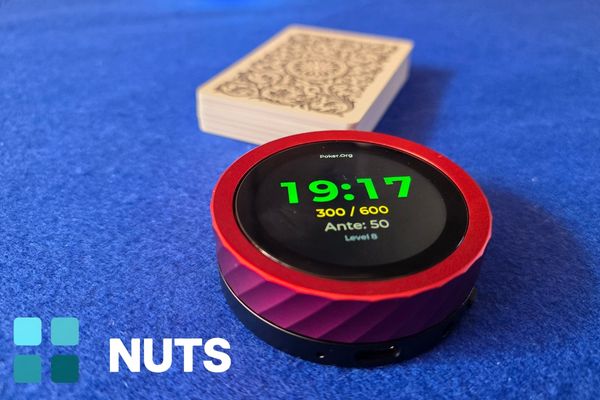
His solution is deceptively simple yet technologically sophisticated. The NUTS device replaces the standard dealer button with a touchscreen-enabled version that displays all relevant tournament data. Current prototypes show level time remaining, active blind amounts, upcoming blinds, and the complete tournament structure. The buttons sync wirelessly across multiple tables, ensuring every player has identical information regardless of where they’re seated.
Testing has primarily occurred in pub and club poker games throughout London, where 3-5 table tournaments typically lack dedicated clock infrastructure. These environments have proven ideal for identifying both the device’s strengths and the practical challenges it solves. The buttons charge via USB-C, feature aluminum construction with a rotating outer ring, and include multiple control switches alongside the touchscreen interface.
Beyond basic clock functionality, the system integrates with existing tournament management software, allowing directors to pause all tables simultaneously, adjust structures on the fly, and implement different permission levels for staff. Wrist-based versions enable floor personnel to control tournaments from anywhere in the venue. Future development may incorporate chess clock functionality similar to what’s used in high-stakes Triton events.
The Poker Strategy Breakdown
Access to tournament information directly impacts strategic decision-making in ways many players underestimate. When you’re grinding a short stack near the bubble, knowing exactly how many minutes remain before blinds increase can completely alter your approach. The difference between having three minutes versus eight minutes might determine whether you wait for a premium hand or make a move with any reasonable holding.
Consider a typical bubble scenario: you’re sitting on 12 big blinds with blinds increasing in four minutes. Without clear visibility to this information, you might fold marginal spots that actually require immediate action. Conversely, if you overestimate the time pressure, you might shove with dominated hands when you could afford to wait one more orbit for a stronger opportunity. This information asymmetry creates unnecessary variance in tournament results.
The strategic value extends beyond individual decisions. In multi-table tournaments, synchronized clocks ensure all tables operate under identical conditions. We’ve all experienced situations where one table plays significantly faster or slower than others, creating timing discrepancies that affect bubble dynamics and payout considerations. When Table 1 is already in the money while Table 2 is still hand-for-hand, players receive unequal information about ICM pressure and optimal strategy adjustments.
Shot clock functionality addresses another strategic dimension entirely. In home games and smaller tournaments, time-banking becomes contentious without formal systems. Players tank excessively, debates erupt about what constitutes reasonable thinking time, and game flow suffers. Implementing consistent timing standards professionalizes the experience and forces players to develop better instincts rather than relying on unlimited deliberation.
The psychological element shouldn’t be overlooked either. When players can easily monitor time remaining, they experience less anxiety about missing critical information. This mental bandwidth can be redirected toward actual poker decisions rather than constantly craning necks to check wall clocks or asking dealers for updates. Reducing cognitive load in this manner allows players to focus on opponent tendencies, stack sizes, and positional dynamics.
Reading The Field & Table Dynamics
Tournament clocks visible at every seat fundamentally change how the entire table responds to time pressure. In traditional setups, players positioned facing the clock have informational advantages over those seated with their backs to it. This creates subtle but real edges in timing-based decisions. Equalizing access to this data levels the playing field and shifts edges back toward pure poker skill.
ICM considerations become more precise when all players have identical information about tournament progression. Near bubble situations, for instance, require constant recalculation as stacks change and players bust. If you’re unsure whether three or four more eliminations are needed to reach the money, your calling ranges and shoving frequencies can’t be properly calibrated. Real-time data eliminates this guesswork.
The device also impacts table dynamics during break periods. In conventional tournaments, players often remain confused about break duration, leading to late returns and disrupted play. When every table displays synchronized break timers, players return promptly and play resumes efficiently. This seemingly minor improvement compounds over long tournament sessions, potentially adding several hands of play and reducing overall event duration.
For tournament directors and hosts, the ability to pause all tables simultaneously creates fairer conditions during technical issues or disputes. Rather than some tables continuing while others wait, universal synchronization ensures no player gains or loses hands relative to the field. This becomes particularly important during hand-for-hand play, where every hand dealt affects bubble dynamics.
The permission-based control system prevents unauthorized adjustments while enabling appropriate staff to respond to situations quickly. A floor person can pause the clock to address a ruling without needing to access a central computer or communicate with a control room. This decentralization speeds up tournament administration while maintaining security against accidental or malicious changes.
How To Apply This To Your Game
If you host home games or play in venues without proper tournament infrastructure, technology like this addresses real pain points. The phone-as-timer approach creates numerous problems: only one table sees it, the owner must leave it unlocked during breaks, and if that player busts and leaves, the timer disappears. Dedicated devices eliminate these issues while adding professional polish to your events.
For players, the immediate application involves better time management during tournament play. Start paying attention to how often you check the clock and how that information influences your decisions. When you know exactly how long remains in a level, you can plan your aggression accordingly rather than making reactive decisions based on vague time awareness.
Practice making time-based strategic adjustments in your regular play. If you’re in a home game using phone timers, position yourself where you can see it clearly and consciously factor time remaining into your decisions. Notice how your strategy should shift with eight minutes left versus two minutes left at the same stack depth. This awareness will serve you well in any tournament format.
Tournament directors should consider how technology improves player experience and operational efficiency. Whether through smart dealer buttons or other solutions, providing clear, accessible timing information demonstrates professionalism and reduces player frustration. Small improvements in tournament administration compound into better overall events that players want to return to.
For those developing poker skills, understanding the relationship between time pressure and optimal strategy is crucial. Study how blind increases affect required win rates and how this should modify your ranges. Learn to calculate how many hands you’ll likely see before the next level and whether your stack can survive that duration. These calculations become automatic with practice but require conscious attention initially.
Key Takeaways
- Smart dealer buttons with integrated tournament clocks provide every player equal access to critical timing information, eliminating positional advantages based on screen visibility
- Synchronized multi-table displays ensure fair play during bubble situations and hand-for-hand periods by keeping all tables on identical timing
- Time awareness directly impacts strategic decisions, particularly for short stacks approaching blind increases or bubble situations requiring precise ICM calculations
- Home game hosts can eliminate phone-timer problems while adding professional functionality including break timers, shot clocks, and structure displays
- Permission-based controls allow tournament directors to manage events efficiently while preventing unauthorized adjustments to structures or timing
- Future development may include chess clock functionality and additional features that further professionalize smaller poker events
Frequently Asked Questions
How does having a clock at every table improve poker strategy?
Direct access to timing information allows players to make more precise decisions based on blind increases, break schedules, and tournament progression. When you know exactly how many minutes remain before blinds increase, you can adjust your aggression appropriately rather than guessing. This eliminates information asymmetry between players who can see wall clocks and those who cannot, creating fairer conditions based purely on poker skill.
Can smart dealer buttons work for home games without internet?
Yes, the NUTS system includes built-in tournament management for standalone operation without internet connectivity. Multiple buttons sync via internal networking that doesn’t require internet traffic, eliminating delays and connectivity issues. A companion mobile app allows hosts to configure tournament structures and send them to the devices, making setup straightforward even for casual home games.
What advantages do synchronized clocks provide during tournament bubbles?
Synchronized clocks ensure all tables in a tournament operate under identical conditions during critical bubble periods. This prevents situations where some tables play faster than others, creating timing discrepancies that affect ICM calculations and payout equity. When every table shows the same information simultaneously, hand-for-hand play becomes fairer and players can make more accurate strategic adjustments based on tournament-wide conditions rather than table-specific timing.
Final Thoughts
Innovation in poker often focuses on online platforms and digital tools, but live poker infrastructure deserves equal attention. The smart dealer button concept addresses genuine problems that players and tournament directors face regularly. While it may seem like a luxury for professional card rooms with extensive display systems, the real value emerges in environments where such infrastructure doesn’t exist—home games, pub tournaments, and smaller venues that host poker without dedicated equipment.
The broader implication involves how technology can enhance live poker without fundamentally changing the game’s nature. Unlike electronic tables or automated dealing systems that transform the playing experience, a smart dealer button simply makes existing information more accessible. It’s an augmentation rather than a replacement, maintaining poker’s traditional feel while eliminating unnecessary friction points.
As poker continues evolving, solutions that bridge the gap between professional tournament standards and casual game accessibility will become increasingly valuable. Whether this specific device becomes ubiquitous or inspires similar innovations, the underlying principle remains sound: players perform better when they have clear, equal access to the information they need to make strategic decisions. That’s good for the game at every level.
Ready to Sharpen Your Poker Game?
Master your poker game with expert hand analysis