

When You Think You’ve Won: Eggenberger’s WSOPE Comeback
Anca Eggenberger captured the first-ever Ladies bracelet awarded in Europe at the 2026 WSOPE, but the victory almost slipped through her fingers in the most brutal way imaginable. After being dominated heads-up and making a flush on the river that her opponent didn’t immediately see, Eggenberger completed one of the tournament’s most dramatic comebacks on Easter Sunday.
What Happened
The €1,000 WSOPE Ladies Championship attracted 197 entries and generated a prize pool of €179,270. When Day 2 began, Eggenberger sat in 23rd place out of 30 remaining players with a meager nine big blinds. The odds weren’t in her favor, but she navigated the shallow-stacked minefield with precision.
The final table featured a who’s who of international talent, with Daria Krashennikova leading the counts at 1,955,000 chips. Eunbeen Joo sat second with 1,745,000, while Eggenberger had climbed to third with 930,000. Other notable finalists included Esther ‘Etay’ Taylor, who had eliminated Paulina ‘Poker Bunny’ Loeliger on the final table bubble.
As the final table progressed, Eggenberger and Joo emerged as the dominant forces, trading eliminations back and forth. When heads-up play commenced, Eggenberger held a slight advantage, but Joo quickly seized control and built what appeared to be an insurmountable chip lead.
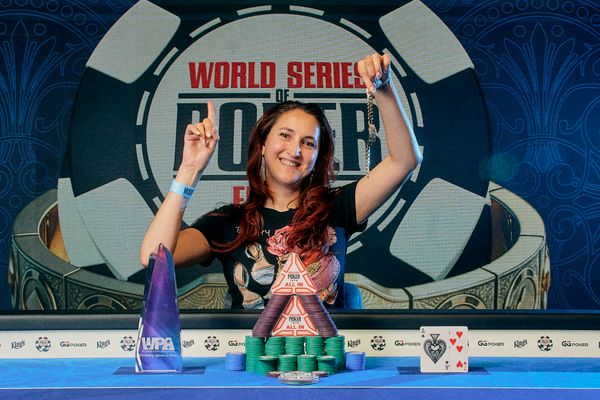
Then came the hand that changed everything. Eggenberger moved all-in holding seven-deuce offsuit—the worst starting hand in poker. Joo, riding high with her massive chip advantage, made a loose call with king-nine offsuit. The flop brought Joo a pair of nines, and the turn gave her two pair. She was one card away from victory.
Eggenberger muttered “Urgh” as the turn fell, seemingly accepting her fate. But the river delivered a miracle—completing a flush for Eggenberger’s seven-deuce. In the chaos of the moment, nobody noticed immediately. Joo tapped the table repeatedly, convinced she’d just won her first bracelet. Eggenberger stood up to leave before suddenly realizing what had happened and exclaiming “Flush!” as she sat back down.
The psychological damage was done. Joo never recovered from thinking she’d won, only to have victory snatched away. A few hands later, with stacks nearly even, Eggenberger shoved with ace-king. Joo made another loose call, this time with ace-ten. The flop gave both players pieces, but the turn sealed Eggenberger’s resurrection—a comeback completed on Easter Sunday after being dead to rights just moments earlier.
The Poker Strategy Breakdown
The final hand sequence reveals several critical strategic concepts that separate tournament poker from cash games. Eggenberger’s seven-deuce shove wasn’t reckless—it was mathematically sound given the tournament situation. With blinds at 20K/40K/40K and shallow effective stacks, any two cards have significant equity when you’re all-in.
Joo’s call with king-nine offsuit deserves scrutiny. While she had a commanding chip lead, calling an all-in with K9o is marginal at best, even in a dominant position. The hand doesn’t perform well against most shoving ranges, and giving your opponent a chance to double up when you’re in control represents questionable risk management.
This becomes even more apparent when we consider pot odds and equity. Against a random hand, K9o has roughly 60% equity. Against a polarized shoving range that includes premium hands and bluffs, that equity drops significantly. Joo was risking her dominant position for a call that, while likely ahead, wasn’t crushing enough to justify the tournament implications.
The second crucial hand—where Eggenberger shoved ace-king and Joo called with ace-ten—illustrates a different strategic error. After the psychological blow of the previous hand, Joo should have tightened up considerably. Calling off with ace-ten when stacks are even represents a significant leak. She was dominated by any ace-king, ace-queen, or pocket pair above tens, and only slightly ahead of hands like ace-jack or ace-nine.
From Eggenberger’s perspective, the ace-king shove was textbook. With stacks roughly even and holding a premium hand, getting chips in the middle is always correct. The hand plays well both called and uncalled, representing optimal risk-reward in a tournament setting.
Reading The Field & Table Dynamics
The tournament’s structure created fascinating dynamics from the opening hands. Day 1 featured champagne and a celebratory atmosphere, with poker legends like Annette Obrestad in attendance. But Day 2 shifted dramatically—ten players busted in the first thirty minutes, and the mood turned serious with €40,298 and a pink diamond bracelet on the line.
Shallow stack play dominated the final table. With nine players and an average stack of just 25 big blinds, ICM (Independent Chip Model) considerations became paramount. Every decision carried outsized consequences, and players couldn’t afford to wait for premium hands.
Eggenberger’s early position—starting Day 2 with nine big blinds in 23rd place—forced her into push-fold mode immediately. This actually simplified her decisions and eliminated marginal spots where mistakes accumulate. She either shoved or folded, removing complex postflop scenarios from the equation.
The heads-up dynamic revealed how psychological factors override pure mathematics. Joo’s chip lead should have allowed her to apply relentless pressure, forcing Eggenberger into difficult decisions. Instead, she made two loose calls in quick succession—the second clearly influenced by the emotional devastation of the first.
Tournament poker at this stage isn’t just about cards and chips. It’s about managing emotions, recognizing when opponents are tilting, and understanding that one hand can completely shift momentum. Eggenberger recognized Joo’s vulnerability after the seven-deuce hand and capitalized immediately.
How To Apply This To Your Game
The first lesson is simple but often ignored: never celebrate until chips are pushed your way. Joo’s premature table-tapping cost her psychologically. In your games, maintain composure until the dealer announces the winner. This prevents embarrassment and keeps you mentally sharp for the next hand.
Second, understand that chip leads in tournaments aren’t as valuable as they appear. Joo’s dominance evaporated in two hands because she made loose calls trying to end the tournament quickly. When you have a big stack, you can afford to be patient. Don’t give opponents cheap opportunities to double through you with marginal holdings.
Third, recognize when you’re emotionally compromised. After a brutal beat or near-miss, take a moment to reset. Joo’s second loose call came directly after her crushing disappointment. If she’d taken a deep breath and folded ace-ten, she’d still have had chips to work with. Instead, she compounded one mistake with another.
Fourth, embrace short-stack play rather than fearing it. Eggenberger’s nine big blind start on Day 2 forced her into a simplified strategy that eliminated marginal decisions. Many players panic when short-stacked, but it’s often easier to play correctly with fewer options. Push-fold charts exist for a reason—use them.
Finally, understand that any two cards can win in the right situation. Eggenberger’s seven-deuce wasn’t a “bad beat”—it was a standard all-in confrontation where the underdog hit. If you’re making correct mathematical decisions, you’ll lose these hands roughly as often as the percentages suggest. Don’t let short-term results influence long-term strategy.
Key Takeaways
- Chip leads are fragile in tournaments: Joo’s commanding advantage disappeared in two hands because she made loose calls instead of playing patiently with her stack.
- Psychological resilience matters: The emotional impact of thinking you’ve won, then realizing you haven’t, can be devastating—Joo never recovered mentally.
- Short stacks require simplified strategies: Eggenberger’s nine big blind start forced her into push-fold mode, which actually made her decisions easier and more profitable.
- ICM pressure changes optimal play: With shallow stacks and significant pay jumps, every decision at the final table carried magnified consequences beyond simple chip equity.
- Position and aggression trump patience heads-up: Eggenberger’s willingness to move all-in with marginal holdings put maximum pressure on Joo, who made defensive mistakes.
- Never celebrate prematurely: Joo’s table-tapping before confirming victory created unnecessary psychological damage that influenced her subsequent decisions.
Frequently Asked Questions
Was Joo’s king-nine call a mistake given her chip lead?
Yes, this was a marginal call at best. With a commanding chip lead, Joo could afford to be selective and wait for stronger holdings. K9o doesn’t perform well enough against most shoving ranges to justify risking a double-up when you’re in control. The better play would have been to fold and maintain pressure through selective aggression rather than loose calling.
How should you recover mentally after thinking you’ve won but haven’t?
Take a deliberate pause before the next hand. Use a time bank if available, step away from the table briefly if permitted, or simply take several deep breaths. The key is recognizing you’re emotionally compromised and consciously resetting your mental state. Don’t make any significant decisions until you’ve regained composure—this might mean folding a few hands that you’d normally play.
What’s the correct strategy when short-stacked at a final table?
With 10-15 big blinds or fewer, shift to a push-fold strategy. Identify profitable shoving spots based on your position, opponents’ calling ranges, and ICM considerations. Avoid limping or making small raises that commit too many chips without the ability to fold. Use tools like push-fold charts to understand which hands are profitable shoves from each position, and execute without hesitation when the math supports it.
Final Thoughts
Anca Eggenberger’s victory at the 2026 WSOPE Ladies Championship demonstrates that tournament poker rewards resilience as much as technical skill. Starting Day 2 as one of the shortest stacks, she navigated treacherous waters to reach heads-up play, then capitalized on her opponent’s psychological vulnerability at the critical moment. The seven-deuce flush that Joo didn’t immediately see will be replayed in poker highlight reels for years—a reminder that you haven’t won until the dealer pushes you the chips.
For Joo, this tournament represents a painful but valuable lesson. Her technical play throughout the event was strong enough to build a dominant chip lead heads-up. But two loose calls—the second clearly influenced by the emotional devastation of the first—cost her the bracelet. The difference between winning and losing at the highest levels often comes down to these marginal decisions in pressure situations.
The broader lesson for all tournament players is that chip leads are temporary, momentum shifts are real, and psychological factors matter as much as mathematical ones. Eggenberger’s comeback wasn’t just about hitting fortunate cards—it was about maintaining composure when short-stacked, recognizing when her opponent was vulnerable, and executing aggressive plays at exactly the right moments. That’s championship poker.
Ready to Sharpen Your Poker Game?
Master your poker game with expert hand analysis
