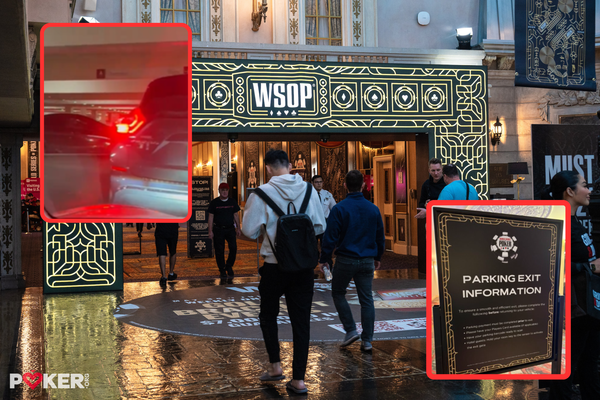
WSOP Parking Chaos: When Off-Table Tilt Costs You More
The World Series of Poker parking nightmare at Paris Las Vegas has become a recurring bad beat that’s testing players’ mental game before they even sit down. Six years into the Strip venue era, frustrated pros are spending up to 40 minutes trapped in exit lines, turning what should be a routine dinner break into a patience-draining ordeal that rivals any river suckout.
What Happened
When the WSOP relocated from the Rio to Horseshoe and Paris Las Vegas in 2022, parking emerged as an immediate concern among the poker community. The Rio, despite its aging facilities and questionable amenities, offered approximately 4,500 free parking spaces across multiple garages with numerous exit points. Players could access their vehicles during breaks without much hassle, maintaining flexibility for meal options and personal errands.
The new Strip location promised over 9,000 spaces spread across multiple garages, seemingly more than adequate for even the busiest tournament days. The cost structure was set at $18 daily or $100 weekly for cash-only passes. Initial reactions from poker’s elite were cautiously optimistic.
Daniel Negreanu praised the convenience of a garage that connected directly to the Paris ballroom via escalator. Even Allen Kessler, known for voicing complaints about tournament conditions, posted positively on June 3, 2022, noting he easily found a Level 2 spot on one of the busiest days, confidently stating the nine-level garage couldn’t possibly sell out.
That honeymoon period didn’t last. By 2023, the cracks started showing. Players’ rewards cards malfunctioned at payment machines, creating bottlenecks. Faraz Jaka documented finishing his tournament session at 12:30 AM only to spend 20 minutes stuck in gridlock trying to exit the garage.
Jeff Platt, before joining WSOP as an employee, publicly called for a complete overhaul of the parking system, noting the machines failed roughly 50% of the time with card readers. The situation deteriorated further in subsequent years.
By 2026, the normally mild-mannered Adam Hendrix issued a stark warning: the parking garage was becoming dangerous, with busted tournament players losing their composure while trapped at exit gates. He predicted bad incidents were inevitable as summer progressed.
Recent reports from 2026 include David “ODB” Baker sitting motionless for 20 minutes and Eric Mizrachi clocking a 40-minute exit time. Even VIP parking hasn’t provided relief. Chris “Big Huni” Hunichen discovered the hard way that improvising parking solutions leads to tow trucks.
The Poker Strategy Breakdown
While parking problems might seem disconnected from poker strategy, they represent a critical mental game challenge that directly impacts your performance. Understanding how to manage frustration from external factors is as important as knowing when to three-bet light.
Consider the psychological impact: you’ve just played a grueling eight-hour session, perhaps taking a brutal beat in a key pot. Your mental reserves are depleted. Now you face another 30-40 minutes of dead time in a concrete garage, watching other frustrated players cut through parking spaces, honking horns, and creating chaos. This compounds your tilt factor exponentially.
The parking situation creates what behavioral psychologists call “decision fatigue.” Every additional stressor—malfunctioning card readers, unclear signage, aggressive drivers—depletes your cognitive resources. These are the same mental reserves you need for making optimal decisions at the poker table.
Professional players understand that bankroll management extends beyond buy-ins. It includes time management, energy conservation, and stress mitigation. A 40-minute parking ordeal after a session doesn’t just waste time; it erodes your mental capital for the next day’s play.
The strategic approach requires planning around this known variable. Just as you’d adjust your ranges based on table dynamics, you must adjust your logistics based on venue realities. This means treating parking as part of your tournament preparation, not an afterthought.
Some players have adopted a “parking ICM” mindset—calculating the real cost of convenience versus alternatives. Is paying $18 for problematic Paris parking worth it compared to parking at Bellagio and walking, or using the Monorail from a distant casino? The time investment, physical energy, and mental stress all factor into this equation.
Reading The Field & Table Dynamics
The parking crisis reveals broader dynamics about how tournament venues impact player performance. Observant players can leverage this information for strategic advantage.
Players arriving late or visibly frustrated from parking ordeals often display tells in their early play. They might be more aggressive, trying to build a stack quickly to justify the hassle. Or they might play overly tight, already tilted and afraid of busting after such an ordeal to even arrive.
Understanding the venue’s logistical challenges helps you read opponent psychology. That regular who’s usually calm but seems agitated? He probably just spent 35 minutes exiting the garage during dinner break. This affects his decision-making, potentially making him more exploitable.
The parking problem also influences tournament attendance patterns. Savvy players notice that certain flight times might be less crowded because recreational players avoid peak parking hours. This changes the field composition and adjusts your optimal strategy.
Local professionals like Shannon Shorr have developed workarounds and “parking hacks,” giving them an edge over out-of-town players who don’t know the alternatives. This local knowledge translates to arriving fresher and more focused—a legitimate competitive advantage.
Tournament directors and staff are aware of these issues, but their hands are largely tied. As Jeff Platt has acknowledged while fielding complaints, this is a Caesars operations problem, not something WSOP can directly fix. WSOP employees park in the same garages and face identical frustrations.
How To Apply This To Your Game
The parking situation offers practical lessons for improving your overall poker performance through better life management around the game.
Build in buffer time: If you’re playing a WSOP event, add 30-45 minutes to your expected parking and exit times. This prevents the stress of running late and allows you to arrive mentally fresh. Treat it like pot odds—calculate the true time investment, not the optimistic scenario.
Explore alternatives early: During your first days at the series, test different parking options. Try the Bellagio garage, the open lot behind Paris, or parking along the Monorail route. Find what works best for your schedule and stress tolerance. This reconnaissance pays dividends throughout the summer.
Use dead time productively: If you’re stuck in parking gridlock, have a mental game routine ready. Listen to a poker podcast, review hand histories on your phone, or practice breathing exercises. Transform wasted time into productive time.
Consider rideshare economics: Calculate whether Uber or Lyft might be more cost-effective than daily parking when you factor in time, stress, and mental energy. Sometimes paying $25 for a ride beats paying $18 plus 40 minutes of frustration.
Adjust your session planning: If possible, schedule your exits during off-peak hours. Leaving at 2 AM might mean an empty garage. Leaving at midnight puts you in the worst traffic. Strategic timing matters.
Protect your mental game: Recognize when external frustrations are affecting your play. If parking problems have you tilted before you sit down, take extra time to reset mentally. Perhaps grab a coffee, take a walk, or do whatever helps you recenter.
Key Takeaways
- WSOP parking at Paris Las Vegas has been problematic since 2022, with issues escalating each year despite over 9,000 available spaces
- Exit times of 30-40 minutes have become common during peak hours, with malfunctioning payment machines and card readers creating bottlenecks
- The parking situation represents a mental game challenge that depletes cognitive resources needed for optimal poker decisions
- Alternative parking options exist at Bellagio, Planet Hollywood, the lot behind Paris, and casinos along the Monorail route
- Professional players treat parking logistics as part of tournament preparation, not an afterthought, building buffer time into their schedules
- This is primarily a Caesars operations issue rather than a WSOP problem, meaning significant improvements may not be forthcoming
Frequently Asked Questions
How much does WSOP parking cost at Paris Las Vegas?
Parking costs $18 per day or $100 per week. Weekly passes must be purchased with cash only. However, given the ongoing problems with exit delays and malfunctioning machines, many players are exploring alternative parking locations that may offer better value when factoring in time and frustration.
What are the best alternatives to Paris parking for WSOP players?
Several viable alternatives exist: Bellagio’s parking garage offers relatively easy access with a short walk; Planet Hollywood provides another Strip option; the open lot behind Paris can be more convenient for quick exits; and parking at any casino along the Las Vegas Monorail route allows you to use public transportation to reach the venue. Local pros have also identified various other spots through trial and error.
Why hasn’t WSOP fixed the parking problems after six years?
The parking facilities are operated by Caesars Entertainment’s operations team, not by WSOP directly. While WSOP can communicate player concerns to Caesars management, they don’t control the garages, payment systems, or staffing decisions. WSOP employees face the same parking challenges as players, indicating this is a broader corporate operations issue rather than something tournament organizers can directly resolve.
Final Thoughts
The WSOP parking saga at Paris Las Vegas serves as a reminder that poker success extends far beyond the felt. Your edge comes not just from superior hand reading or GTO strategy, but from managing every aspect of the tournament experience—including the mundane logistics that drain mental energy.
Six years into the Strip era, it’s clear these parking problems aren’t getting resolved quickly. Rather than hoping for improvement, adapt your approach. Treat parking as a known variable in your tournament planning, just as you’d account for blind structures or payout considerations. The players who manage this frustration most effectively gain a legitimate competitive advantage over those who let it tilt them before cards are even dealt.
Whether you’re grinding the entire WSOP schedule or playing a few events, your preparation should include a parking strategy. Scout alternatives, build in buffer time, and protect your mental game from off-table stressors. The best players optimize every element of their tournament experience—and that includes how they arrive and depart from the venue.
Ready to Sharpen Your Poker Game?
Master your poker game with expert hand analysis