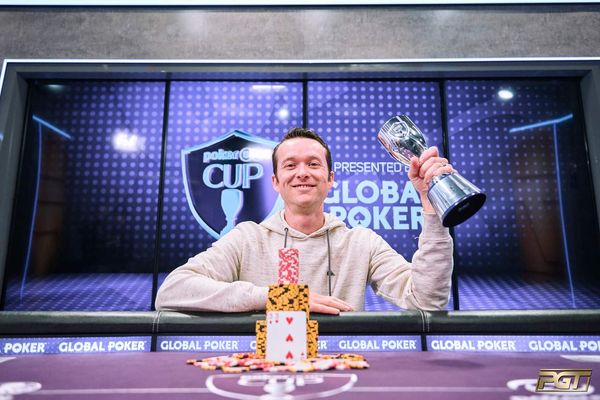
Kent Stephens Conquers 5-to-1 Deficit in Record PGT Win
An unknown player with barely five figures in career earnings just turned a $3,000 investment into $130,000—and did it by erasing a massive chip disadvantage at the final hurdle. Kent Stephens’ victory at the PokerGO Cup Showcase represents more than just a feel-good story; it’s a masterclass in tournament survival and heads-up resilience.
What Happened
The PokerGO Cup Showcase made history this week, drawing 215 entries across two starting flights—the largest field ever assembled for a Poker Grand Tour event held inside the PokerGO Studio. The tournament’s $3,000 buy-in was strategically positioned to welcome fresh faces to the tour, and the gamble paid off spectacularly.
By the time Day 2 rolled around, 31 players remained in contention, all guaranteed a payday from the $645,000 prize pool. The elimination pace was relentless. High-profile regulars including Chino Rheem, Jonathan Little, Sean Winter, Cary Katz, Daniel Sepiol, Joao Simao, and Dylan Linde all hit the rail before the final seven convened.
At that final table, Kent Stephens found himself surrounded by far more accomplished players. Natalie Ferguson, Daniyal Gheba, Sandeep Koralla, Jim Collopy, and Aaron Messmer all fell by the wayside, setting up a heads-up battle between Stephens and Myles Mullaly—a player with over $1.2 million in career earnings.
Mullaly seized early control, building a commanding chip lead that exceeded 5-to-1 at its peak. But Stephens refused to fold. Through patient aggression and calculated risk-taking, he clawed his way back into contention before ultimately claiming the title and $130,000 top prize. The win multiplied his lifetime tournament earnings by 11.6x, catapulting him from $12,232 to $142,232.
The Poker Strategy Breakdown
Coming back from a 5-to-1 chip deficit in heads-up play isn’t about luck—it’s about understanding leverage, pot geometry, and pressure dynamics. When you’re the short stack, every decision carries amplified importance, but so does your fold equity against an opponent who suddenly has something to lose.
The key strategic principle Stephens likely employed is what tournament specialists call “controlled aggression under pressure.” With blinds escalating and his stack dwindling, passive play would have been suicide. Instead, he needed to identify spots where Mullaly might be defending his lead conservatively, then attack those vulnerabilities with well-timed shoves and three-bets.
Heads-up dynamics shift dramatically based on stack depth. At 5-to-1 down, Stephens was likely playing with 15-25 big blinds—a zone where push-fold mathematics dominate but reading your opponent’s tendencies becomes equally critical. Against an experienced player like Mullaly, Stephens couldn’t simply rely on Nash equilibrium charts. He needed to exploit patterns, identify when Mullaly was playing fit-or-fold versus when he was defending aggressively.
One crucial element often overlooked in comeback scenarios is psychological momentum. Each pot won by the short stack doesn’t just add chips—it plants seeds of doubt in the chip leader’s mind. Mullaly went from cruising toward victory to suddenly questioning whether his lead was as secure as it appeared. This mental shift can cause chip leaders to make uncharacteristically tight folds or ill-timed hero calls, both of which accelerate the stack transfer.
The final confrontation likely came down to hand reading and commitment. In heads-up play, hand values are elastic—ace-high becomes premium, any pair is powerful, and suited connectors gain tremendous playability. Stephens needed to recalibrate his ranges for this heads-up environment while simultaneously exploiting any tendencies Mullaly displayed during their extended battle.
Reading The Field & Table Dynamics
The Showcase’s structure created a fascinating dynamic from the outset. With 215 entries paying only 31 spots, the bubble pressure was intense. Players who made Day 2 had already survived a grueling elimination gauntlet, but the shallow payout structure meant everyone was gunning for the top prizes—minimum cashes wouldn’t justify the time investment.
This created an aggressive Day 2 environment where ICM considerations took a backseat to chip accumulation. When elite regulars like Rheem, Little, and Winter all busted before the final table, it signaled that players were taking calculated risks rather than laddering conservatively. For Stephens, this aggressive field dynamic actually worked in his favor—he could play his game without facing the ultra-tight, ICM-optimal strategies that dominate higher buy-in events.
At the final table, Stephens faced a mixed lineup of seasoned professionals and hungry competitors. Ferguson brought final table experience from multiple tours. Gheba and Koralla had proven themselves in similar spots. Collopy and Messmer were solid professionals who wouldn’t make obvious mistakes. And Mullaly represented the most dangerous opponent—experienced enough to punish errors but not so conservative that he couldn’t be outplayed.
The key to Stephens’ success was likely his ability to remain unpredictable. Without an extensive track record, opponents couldn’t exploit known tendencies. This anonymity becomes an asset when facing players who rely heavily on database information and opponent history. Every decision Stephens made provided new data points, but his opponents were building his profile in real-time rather than arriving with a pre-formed strategy.
During heads-up play, the dynamic shifted entirely. With no ICM considerations and all focus on chip accumulation, both players could unleash their full arsenals. Mullaly’s experience suggested he’d be comfortable in this spot, but Stephens’ lack of baggage—no previous heads-up defeats to haunt him, no established reputation to protect—may have given him a psychological edge.
How To Apply This To Your Game
Stephens’ victory offers several actionable lessons for tournament players at every level. First, understand that chip deficits aren’t death sentences. Too many players adopt a defeated mindset when facing a big stack disadvantage, playing scared and waiting for premium hands that never arrive. Instead, recognize that your opponent’s large stack makes them vulnerable to pressure—they have more to lose with each confrontation.
When you’re short-stacked in heads-up play, expand your shoving range intelligently. You can’t wait for aces or kings. Study push-fold charts for various stack depths, but also observe how your opponent responds to aggression. If they’re folding too much, widen your range further. If they’re calling light, tighten up and wait for legitimate equity.
Position becomes even more critical in heads-up play than in full-ring games. The button acts first preflop but last postflop—a unique dynamic that creates opportunities for both players. When you’re in position, use it to apply maximum pressure with a polarized range. Out of position, consider more linear strategies that realize equity efficiently.
Mental game management separates good players from great ones in comeback situations. Stephens could have tilted after falling behind 5-to-1. Instead, he maintained composure and executed his strategy hand after hand. Develop your own mental reset routines—breathing exercises, positive self-talk, or simply standing up between hands to reset your focus.
Finally, embrace your anonymity when you have it. If you’re playing against more experienced opponents who don’t know your game, use that information asymmetry to your advantage. Make plays that established players might avoid because they’re worried about their image. Sometimes being unknown is the best table image you can have.
Key Takeaways
- The PokerGO Cup Showcase’s $3,000 buy-in successfully attracted a record 215 entries, proving that lower price points can build bigger fields without sacrificing competitive quality
- Kent Stephens overcame a 5-to-1 chip deficit in heads-up play through controlled aggression and psychological resilience, demonstrating that tournament poker rewards mental fortitude as much as technical skill
- Anonymity can be a strategic asset—without an extensive track record, Stephens’ opponents couldn’t exploit known tendencies or adjust their strategies based on database information
- Heads-up comebacks require expanding your ranges, applying pressure strategically, and recognizing that chip leaders often play more conservatively to protect their advantage
- The elimination of multiple high-profile pros before the final table shows that tournament variance affects everyone—skill edge matters over large samples, but single-tournament results remain highly volatile
- Stephens’ 11.6x career earnings multiplier from a single win illustrates the life-changing potential of tournament poker, especially for players willing to take shots at competitive fields
Frequently Asked Questions
How did Kent Stephens overcome such a massive chip deficit in heads-up play?
Stephens likely employed a strategy of controlled aggression, identifying spots where his opponent Myles Mullaly was defending conservatively and attacking those vulnerabilities with well-timed all-ins and three-bets. When facing a 5-to-1 deficit, passive play leads to inevitable elimination as blinds consume your stack. Instead, Stephens needed to apply pressure, force difficult decisions on his opponent, and capitalize on any momentum shifts. Each pot won not only added chips but also created psychological pressure on Mullaly, who went from cruising toward victory to suddenly defending a shrinking lead.
What advantages do unknown players have against experienced professionals?
Players without extensive track records benefit from information asymmetry—their opponents can’t reference database statistics, previous hand histories, or known tendencies. This forces experienced players to build a profile in real-time rather than arriving with pre-formed strategies. Unknown players can also make unconventional plays without worrying about damaging their reputation or creating exploitable patterns for future encounters. This anonymity becomes particularly valuable at final tables where every opponent is studying everyone else for edges.
Why did the PokerGO Cup Showcase attract such a large field compared to other PGT events?
The $3,000 buy-in represented a strategic price point—low enough to be accessible to semi-professional and serious recreational players, but high enough to maintain competitive integrity and build a substantial prize pool. Many PGT events feature $10,000+ buy-ins that limit the field to elite professionals and high-stakes players. By offering a more affordable entry point with the same professional production and tour prestige, the Showcase attracted players who might normally avoid PGT events, resulting in the record 215-entry field.
Final Thoughts
Kent Stephens’ victory at the PokerGO Cup Showcase represents everything compelling about tournament poker. An unknown player enters a field of established professionals, survives a grueling two-day battle, and then stages an improbable comeback against a massive chip deficit to claim life-changing money. It’s the kind of story that keeps players coming back to the felt, believing that their breakthrough moment might be just one tournament away.
But beyond the narrative appeal, this result offers genuine strategic value. Stephens didn’t win through luck alone—he executed sound fundamentals under immense pressure, adapted his strategy to different opponents and stack depths, and maintained mental composure when many players would have crumbled. These are learnable skills that separate consistent winners from perpetual also-rans.
The Showcase’s success also validates the PGT’s experiment with more accessible buy-ins. Tournament poker thrives on field diversity—when unknown players can compete against established pros on equal footing, the game remains dynamic and unpredictable. Stephens’ win will inspire countless other players to take their shot, knowing that skill and determination can overcome experience and reputation. That’s healthy for the ecosystem and creates the kind of aspirational moments that grow the game.
Ready to Sharpen Your Poker Game?
Master your poker game with expert hand analysis