

Mizrachi Defeats Hellmuth in WSOP $25K Heads-Up Clash
The 2025 Main Event champion Michael Mizrachi eliminated Phil Hellmuth in a battle of WSOP titans during the third round of the $25,000 Heads-Up Championship’s opening flight. The showdown between poker’s old guard and new blood headlined Friday night’s action on the brand-new Paris Ballroom stage, where 64 players competed across three elimination rounds.
What Happened
The WSOP’s premier heads-up event kicked off with a revamped format featuring two opening flights, each consisting of three rounds of single-elimination matches. Players who survived all three rounds secured their spots for Sunday’s Day 2, while those eliminated would need to fire again in the second flight or head home empty-handed.
The inaugural flight delivered immediate drama. Doug Polk’s tournament ended in brutal fashion during Round 1 when Alex Keating cracked his pocket aces with ace-king. Polk got his stack in the middle as a massive favorite, and the flop kept him ahead. But the turn brought a king, and Keating’s rivered straight sealed Polk’s fate before the night truly began.
Phil Ivey made his first 2026 WSOP appearance but couldn’t navigate past Darren Elias in the opening round. Other notable early exits included Sergio Aido, Kevin Rabichow, and Texas Mike Moncek, all falling before the field narrowed to 32 players.
Round 2 featured Martin Kabrhel’s signature table talk against the more reserved Masato Yokosawa. Despite dominating the livestream audio, Kabrhel couldn’t overcome a massive cooler that sent him packing. Meanwhile, Hellmuth successfully bluffed David ‘ODB’ Baker to advance, and Daniel Negreanu dispatched Brock Wilson to reach the final 16.
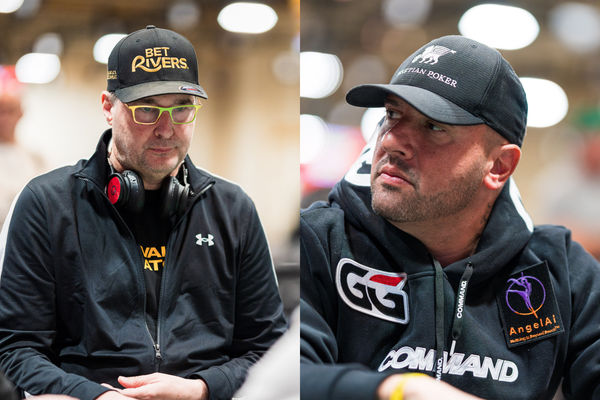
The evening’s centerpiece arrived at 10pm when Hellmuth and Mizrachi squared off. The matchup pitted the 1989 World Champion seeking his 18th bracelet against the player who captured poker’s most prestigious title just months earlier. From the outset, nothing broke Hellmuth’s way. He ran pocket aces into two pair in one hand, then met his demise when both players turned two pair on a board showing queen-nine-seven-nine.
Mizrachi held queen-nine for the superior two pair and raised. Hellmuth, holding ace-seven, shoved his remaining chips into the middle. The river bricked out, and the Poker Brat’s night ended at the hands of the reigning Main Event champion. Mizrachi confirmed he’d play Saturday’s $550 Mystery Bounty before returning for Sunday’s continuation.
Negreanu advanced past Harvey Castro after a pivotal bluff with pocket sixes convinced Castro to fold pocket kings. The momentum shift proved decisive, and the six-time bracelet winner secured his Day 2 berth. Alex Foxen staged the night’s most dramatic comeback, rallying from a significant chip deficit against Joey Weissman in the final match to complete play.
The Poker Strategy Breakdown
The Hellmuth-Mizrachi elimination hand showcases a fundamental heads-up concept: understanding when your two pair is vulnerable. On a Q♠9♥7♦9♣ board, Hellmuth’s A♥7♥ gave him aces and sevens, a strong holding in most scenarios. However, the paired board creates numerous combinations that beat this hand—any queen, any nine, and pocket sevens all have him crushed.
Mizrachi’s Q♦9♦ for queens and nines represents the second-best possible two pair on this runout. His turn raise served dual purposes: extracting value from worse hands like ace-queen or overpairs, while also protecting against straight draws and preventing free rivers. When Hellmuth jammed, Mizrachi faced a straightforward call with a hand that beats virtually everything except pocket queens or quad nines.
Hellmuth’s shove represents a critical error in hand reading. Against an aggressive opponent raising the turn on a paired board, ace-seven simply doesn’t hold enough equity to justify an all-in move. The hand beats bluffs and perhaps some weaker aces, but loses to the vast majority of value hands an opponent would raise for value on this texture.
The earlier hand where Negreanu bluffed Castro off pocket kings demonstrates advanced heads-up aggression. With only a pair of sixes, Negreanu fired a substantial bet that represented a polarized range—either a very strong hand or air. Castro’s fold, while painful in retrospect, wasn’t necessarily incorrect without additional information about Negreanu’s betting patterns. However, in heads-up play, calling down with overpairs becomes increasingly important as opponents apply pressure.
Polk’s elimination illustrates variance’s cruel reality. Getting aces in preflop against ace-king gives you roughly 93% equity—about as good as it gets in hold’em. The flop maintained his advantage, but poker’s mathematics don’t guarantee outcomes. Keating needed to hit one of three remaining kings or runner-runner for a straight, and the poker gods delivered. No strategic adjustment prevents these outcomes; they’re simply part of the game’s fabric.
Reading The Field & Table Dynamics
The $25,000 buy-in creates a unique dynamic where every match features world-class players, eliminating the soft spots typically found in larger-field tournaments. This format demands constant adaptation because you can’t wait for premium situations—the blinds escalate, and aggressive play becomes mandatory.
Kabrhel’s verbal warfare against Yokosawa highlighted contrasting approaches to psychological warfare. Kabrhel’s constant chatter aims to disrupt opponents’ concentration and force mistakes through irritation. Yokosawa’s silence represents the opposite philosophy: let your play speak while maintaining emotional equilibrium. In this instance, the cards decided the outcome through a cooler, but both approaches have merit depending on opponent type.
The heads-up format eliminates ICM considerations entirely—you either win the match or you’re eliminated. This binary outcome encourages more aggressive play than traditional tournament structures. Players can’t ladder up pay jumps or survive into the money through conservative play. Every decision carries maximum consequence, making hand selection, position, and aggression frequency paramount.
Hellmuth’s struggles against Mizrachi also reveal generational differences in approach. Modern players like Mizrachi grew up studying solver outputs and understanding balanced ranges. While Hellmuth’s tournament record speaks for itself, heads-up play rewards the mathematical precision and aggression that characterize contemporary poker theory.
How To Apply This To Your Game
The most critical lesson from this event: in heads-up play, hand values shift dramatically compared to full-ring games. Ace-seven becomes a premium holding preflop, and you’ll often need to call down with hands that seem marginal in other formats. Tightening up excessively in heads-up situations allows aggressive opponents to run you over.
When facing turn raises on paired boards, reassess your hand strength carefully. If you hold two pair with the lower pair matching the board, you’re only beating bluffs and worse two pair combinations. Against thinking opponents who understand board texture, these raises typically indicate genuine strength. Don’t marry your hand just because you flopped something—poker rewards those who can fold decent holdings when the situation demands it.
Practice aggressive bluffing in heads-up scenarios, but ensure your bluffs tell a coherent story. Negreanu’s successful bluff with sixes worked because his betting pattern represented a credible value range. Random aggression without narrative consistency gets exploited by observant opponents who recognize disconnected betting lines.
Accept variance as an inherent element of poker rather than a personal affront. Polk played his aces perfectly and lost—that’s poker. The key is making +EV decisions repeatedly and trusting the mathematics to reward you over sufficient sample sizes. Single-hand outcomes matter far less than consistent decision-making quality.
Study your opponents’ tendencies before matches when possible. In a $25,000 heads-up championship, you’ll likely face players with extensive footage available online. Understanding whether opponents over-bluff, under-bluff, or play exploitatively versus balanced strategies informs your counter-strategy and provides edges in close spots.
Key Takeaways
- Michael Mizrachi eliminated Phil Hellmuth in Round 3 when his Q-9 held against Hellmuth’s A-7 on a paired board, advancing the 2025 Main Event champion to Day 2
- Doug Polk suffered a brutal beat when Alex Keating cracked his pocket aces with A-K, hitting a king on the turn and rivering a straight in Round 1
- The new two-flight format requires players to win three consecutive matches to secure a Day 2 spot, creating intense single-elimination pressure
- Daniel Negreanu advanced after bluffing Harvey Castro off pocket kings with only a pair of sixes, demonstrating the importance of aggressive heads-up play
- On paired boards with two pair, the lower your kicker pair, the more vulnerable your hand becomes to raises—proceed with extreme caution
- Heads-up play demands significantly wider ranges and more aggression than full-ring formats, as waiting for premium hands allows opponents to steal blinds relentlessly
Frequently Asked Questions
How does the WSOP $25K Heads-Up Championship format work?
The tournament features two opening flights where 64 players compete in each. Players must win three consecutive heads-up matches to advance to Day 2. Those eliminated can re-enter in the second flight if they choose. The format creates intense pressure as a single loss ends your flight, unlike traditional tournament structures with multiple chances to accumulate chips.
Should you ever fold two pair in heads-up play?
Absolutely. The strength of two pair depends heavily on board texture and your opponent’s range. On paired boards, lower two pair becomes vulnerable to better two pair combinations, trips, and full houses. When facing significant aggression from competent opponents on dangerous textures, folding two pair often represents the correct decision. Hand reading and opponent tendencies matter more than absolute hand strength.
What adjustments should cash game players make for heads-up tournaments?
Heads-up tournaments require much wider opening ranges—you’ll play 70-80% of hands from the button rather than the 20-30% typical in full-ring games. Aggression frequency must increase dramatically, as passive play allows opponents to control pots and steal blinds. Additionally, stack depth changes throughout matches affect strategy, requiring comfort with both deep-stacked and short-stacked play. Finally, accept higher variance as the single-elimination format means one bad beat can end your tournament.
Final Thoughts
The opening flight of the $25,000 Heads-Up Championship delivered the drama and high-level poker that makes this format so compelling. Watching Mizrachi defeat Hellmuth in a clash of champions reinforced how heads-up play rewards aggression, mathematical precision, and the ability to hand-read in real-time. The new Paris Ballroom stage and enhanced livestream production showcased these battles in unprecedented detail, giving viewers insight into decision-making at poker’s highest levels.
For players looking to improve their heads-up game, this event provides a masterclass in adaptation and aggression. The willingness to bluff with conviction, the discipline to fold decent hands in bad spots, and the mental fortitude to absorb variance separates elite heads-up players from the rest. Whether you’re playing $25,000 championships or $25 sit-and-gos, these principles translate across all stakes.
As the tournament continues with the second opening flight and eventual Day 2, expect more fireworks from poker’s best. The single-elimination format guarantees that every hand carries maximum consequence, creating the tension that makes championship poker unmissable viewing and invaluable learning material for serious students of the game.
Ready to Sharpen Your Poker Game?
Master your poker game with expert hand analysis
