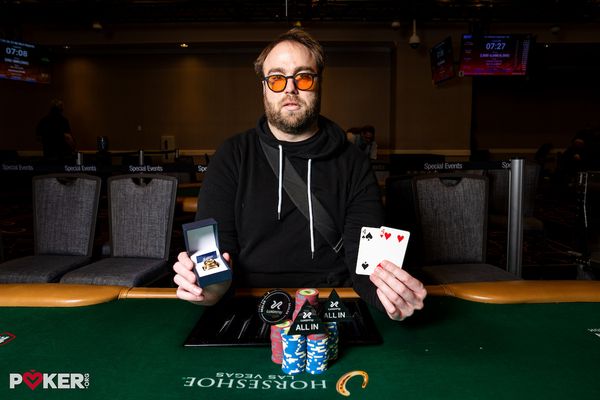
How Matthew Blagg Won His First WSOP Circuit Ring
Matthew Blagg turned a below-average Day 1 chip stack into a $238,470 WSOPC Horseshoe Las Vegas Main Event victory, claiming his first live tournament title and Circuit ring after defeating a field of 936 players. The win showcased textbook tournament poker—surviving crucial all-in situations, exploiting aggressive opponents, and maintaining composure during a grueling heads-up battle.
What Happened
The $1,700 buy-in WSOPC Horseshoe Las Vegas Main Event attracted 936 entries, generating a prize pool of $1,298,780. When the dust settled after four days of competition, Matthew Blagg stood atop the podium with his first live tournament victory and a shiny gold Circuit ring.
Blagg’s path to victory was anything but straightforward. During the dinner break on Day 1B, he found himself nursing a stack smaller than the starting amount. What followed was a remarkable surge that saw him bag 1,200,000 chips—the second-largest stack advancing to Day 2.
The turning point came in a dramatic four-way all-in preflop confrontation where Blagg held ace-king against three premium pocket pairs: kings, queens, and jacks. With his tournament life on the line, the poker gods smiled as four hearts appeared on the board, with Blagg’s ace of hearts giving him the flush to eliminate two opponents and rocket up the leaderboard.
Day 2 saw Blagg quadruple his stack to 4,500,000, entering the final table in fourth chip position. The final table lasted nearly eight hours, with Blagg navigating through several critical all-in situations before ultimately defeating Eric Yanovsky heads-up to claim the title.
The Poker Strategy Breakdown
Blagg’s victory provides several masterclasses in tournament poker strategy, starting with his mental approach. Drawing on extensive online tournament experience—over 1,000 deep runs by his own estimation—he treated the live setting as just another tournament, refusing to let the physical presence of opponents or larger prize money affect his decision-making.
The crucial pocket kings versus pocket jacks confrontation early at the final table demonstrates proper ICM awareness combined with hand-reading skills. With four short stacks at the table and blinds at 120,000, Blagg faced an all-in shove from Jingyang He worth nearly four million chips. Many players would find a fold here with jacks, concerned about pay jumps and the presence of shorter stacks who might bust first.
However, Blagg recognized that his opponent’s shoving range from that position, given the stack sizes and table dynamics, was wider than just premium hands. His call proved correct when He tabled kings—an unfortunate outcome that nonetheless represented sound strategic thinking. Sometimes you make the right play and run into the top of your opponent’s range.
The four-handed pocket aces confrontation against chip leader Eric Yanovsky showcased another critical tournament skill: patience in waiting for premium holdings when facing an aggressive opponent. Yanovsky had been applying maximum pressure, and rather than fighting fire with fire in marginal spots, Blagg waited for a monster and got paid off when Yanovsky shoved for over five million chips.
This hand illustrates a fundamental tournament principle: when facing a hyper-aggressive opponent with a big stack, you don’t need to match their aggression across your entire range. Instead, you can tighten up slightly, wait for strong hands, and let them hang themselves when they run into your value range.
Blagg’s approach to heads-up play revealed mature strategic thinking. He acknowledged Yanovsky’s skill level, admitting he wasn’t sure who held the edge. Rather than trying to outplay his opponent with elaborate bluffs and hero calls, Blagg focused on avoiding major mistakes—a winning formula in tournament poker where a single error can end your run.
Reading The Field & Table Dynamics
One of Blagg’s most insightful comments came when discussing the early final table action: “Not to be too Inside Baseball, but that is generally good if people want to bust. The pay jumps aren’t huge at that point.” This reveals sophisticated ICM understanding.
When pay jumps are relatively flat, aggressive players willing to gamble create profitable situations for skilled opponents. If recreational players or aggressive pros are willing to put their tournament lives at risk in marginal spots, it opens up calling opportunities that wouldn’t exist if everyone played conservatively.
Blagg specifically referenced “wild cards at the table kinda gambling” as a positive development. This observation shows he understood the table composition and adjusted his strategy accordingly. Against tight, conservative opponents, you need to apply more pressure and manufacture chips through aggression. Against loose, gambling opponents, you can tighten up your ranges and get paid when you make hands.
The final table saw rapid eliminations early, with Philip Lucia busting in ninth place within the first 20 minutes. This fast pace suited Blagg’s style and stack size—he had enough chips to be patient but also enough to apply pressure when opportunities arose.
During three-handed play, Blagg found himself as the short stack after Yanovsky won a massive pot against Jia Chi Li. Rather than panicking, Blagg executed a successful shove-through against Yanovsky on the turn, demonstrating the importance of well-timed aggression even from a disadvantaged position. This chip injection allowed him to later eliminate Daniel Lei in third place and enter heads-up play with the chip lead.
How To Apply This To Your Game
The first lesson from Blagg’s victory is the power of mental game and experience translation. If you’ve logged significant volume in online tournaments, you’ve already developed the skills needed for live success. The key is recognizing that the fundamental decisions remain the same regardless of format. Don’t let the live environment intimidate you or cause you to deviate from proven strategies.
Second, understand that tournament poker involves surviving high-variance situations. Blagg’s four-way all-in with ace-king against three pocket pairs was a situation where he was behind but had enough equity to justify being in the hand. You won’t always win these confrontations, but over time, taking mathematically sound gambles is how you accumulate chips and make deep runs.
Third, adjust your strategy based on opponent tendencies and table dynamics rather than rigidly following a predetermined plan. When Blagg identified aggressive players willing to gamble, he tightened his ranges and let them do the betting. When he needed chips three-handed, he found spots to apply pressure. This flexibility is crucial for tournament success.
Fourth, in heads-up situations against skilled opponents, focus on mistake minimization rather than trying to outplay them. Blagg’s acknowledgment that he wasn’t sure who was better between himself and Yanovsky shows self-awareness. Rather than trying to prove superiority through fancy plays, he played solid poker and avoided major errors—a winning approach when skill levels are comparable.
Finally, know the rules and structures of the format you’re playing. Blagg admitted to initially forgetting that live tournament antes heads-up equal the big blind, unlike online where they’re much smaller. While this didn’t cost him the tournament, such oversights can prove expensive. Always confirm tournament-specific rules before play begins.
Key Takeaways
- Translate your online tournament experience to live play—the fundamental decisions remain the same regardless of format
- Embrace calculated risks in high-variance situations when the math supports it, understanding that short-term results don’t invalidate correct decisions
- Adjust your strategy based on opponent types: tighten up against aggressive players willing to gamble, and apply pressure against conservative opponents
- Against skilled heads-up opponents, prioritize avoiding major mistakes over attempting hero plays or elaborate bluffs
- Recognize when pay jump structures favor aggressive play versus conservative survival, and adjust your ranges accordingly
- Maintain composure during downswings—Blagg recovered from below starting stack to victory through patient, disciplined play
Frequently Asked Questions
How did Matthew Blagg’s online experience help him win the WSOPC Main Event?
Blagg credited his 1,000+ online tournament deep runs with preparing him mentally for the final table pressure. He treated the live event as just another tournament, refusing to let the physical presence of opponents or larger prize money affect his decision-making. This experience gave him the confidence to make correct plays in high-pressure situations and maintain composure during crucial confrontations.
What was the key hand that changed Blagg’s tournament trajectory?
The pivotal moment came during Day 1 in a four-way all-in preflop situation where Blagg held ace-king against pocket kings, queens, and jacks. Despite being behind, the board ran out four hearts with Blagg holding the ace of hearts, giving him a flush to eliminate two players and vault near the top of the chip counts. This hand transformed his tournament from a potential early exit to a legitimate title run.
How should you adjust your strategy when facing aggressive opponents at a final table?
Blagg demonstrated that against aggressive opponents willing to gamble, you should tighten your ranges and let them do the betting. Rather than matching their aggression across your entire range, wait for strong hands and allow them to pay you off when they run into your value holdings. This approach is particularly effective when pay jumps are relatively flat and opponents are willing to risk their tournament lives in marginal spots.
Final Thoughts
Matthew Blagg’s maiden live tournament victory at the WSOPC Horseshoe Las Vegas Main Event demonstrates that success in poker comes from a combination of technical skill, mental fortitude, and the ability to run good when it matters most. His journey from below starting stack on Day 1 to hoisting a Circuit ring showcases the variance inherent in tournament poker while also highlighting the importance of sound decision-making throughout.
What separates Blagg’s win from a simple heater is his strategic awareness at every stage. He recognized when to gamble, when to tighten up, and when to apply pressure. He leveraged his online experience without letting the live environment affect his play. Most importantly, he avoided major mistakes during critical moments, particularly in his heads-up battle against a skilled opponent.
For aspiring tournament players, Blagg’s victory offers a blueprint: build experience through volume, translate those skills across formats, adjust to table dynamics, and trust your decisions even when facing variance. Whether you’re grinding online satellites or taking shots at major live events, these principles remain constant. Study hands like the ones Blagg navigated, understand the strategic reasoning behind each decision, and you’ll be better prepared when your own breakthrough moment arrives.
Ready to Sharpen Your Poker Game?
Master your poker game with expert hand analysis