Fujimoto Conquers Schulman’s Reign in $10K Deuce-to-Seven
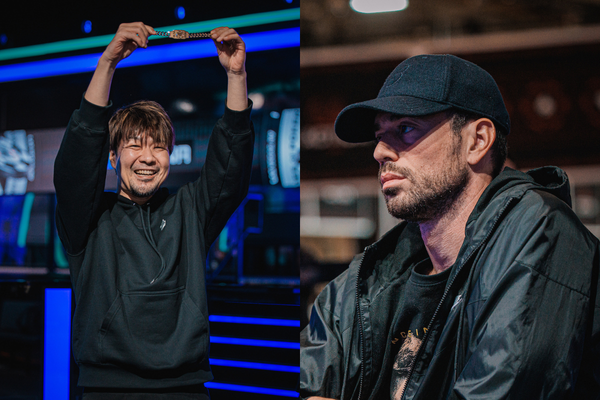
Koji Fujimoto captured his maiden WSOP bracelet in the $10,000 Limit 2-7 Lowball Championship, defeating eight-time champion Nick Schulman in a dramatic heads-up battle. The Japanese mixed games specialist overcame a three-handed deficit to topple poker’s most dangerous final table opponent, earning $392,478 and ending Schulman’s streak of crushing first-time winners.
What Happened
The $10,000 Deuce-to-Seven Lowball Championship concluded on Friday night with 176 entries generating a $1,636,800 prize pool. Twenty-seven players made the money, but all eyes were on the final table showdown between Fujimoto and the player many call the “Final Boss” of the WSOP.
Fujimoto entered the final day as one of eleven remaining players, alongside legends Billy Baxter, Todd Brunson, and Brandon Shack-Harris. Naoya Kihara was also in contention, chasing what would have been his third bracelet of the summer. But it was Fujimoto who navigated through the field, despite finding himself short-stacked with three players remaining.
The decisive hand came down to a classic lowball confrontation. Schulman moved all-in drawing one card with 7-6-4-3 showing, while Fujimoto called and also drew one with 8-5-3-2 exposed. Fujimoto peeled a 6, pairing his hand—typically a disaster in deuce-to-seven. But Schulman’s draw was even worse, pulling a 4 to make a pair of fours and the second-best hand. With that, Fujimoto claimed victory and Schulman’s quest for bracelet number nine fell short.
The finish mirrored last year’s event, where Alexander Wilkinson defeated Schulman for his first bracelet. For Fujimoto, whose previous best WSOP result was a $119,000 score in the 2025 $3,000 HORSE event, this represents a career-defining moment. His Hendon Mob entries only date back to 2024, making this an incredibly fast rise to WSOP glory.
The Poker Strategy Breakdown
Limit 2-7 Lowball (also called Kansas City Lowball) is one of poker’s most skill-intensive variants, rewarding players who understand hand values, drawing odds, and position in ways that differ dramatically from hold’em. The game’s objective is simple: make the worst possible five-card hand, where straights and flushes count against you, and aces are always high.
The final hand between Fujimoto and Schulman illustrates the razor-thin margins in this game. When both players are drawing one card, the mathematics become crucial. With a one-card draw to an 8-low, Fujimoto had seventeen outs to make a non-pairing hand (any card from 4 through King except the 8). Schulman, drawing to a 7-low, had nineteen outs but was already behind if both players paired.
The decision tree in heads-up limit lowball revolves around aggression with made hands and semi-bluffing with strong draws. Position becomes paramount—acting last allows you to see your opponent’s draw decision before making your own. If your opponent stands pat (doesn’t draw), you’re facing a made hand and must evaluate whether your draw is live enough to continue.
Fujimoto’s comeback from short stack at three-handed play demonstrates advanced ICM understanding and hand selection. In limit formats, chip accumulation requires relentless pressure and capitalizing on small edges repeatedly. Unlike no-limit tournaments where one big pot can change everything, limit poker demands consistent execution over dozens of hands.
The key strategic concept in deuce-to-seven is the “number” system. A “Number One” is 7-5-4-3-2 (the nuts). A “Number Two” is 7-6-4-3-2. Players often refer to hands by their number, and understanding the relative strength of your seven or eight is critical to optimal play. An 8-7 low (8-7-4-3-2, for example) is significantly weaker than an 8-6 low, and these distinctions matter enormously in multi-way pots.
Reading The Field & Table Dynamics
The presence of Billy Baxter at the final table added historical weight to the proceedings. Baxter is a seven-time WSOP bracelet winner and arguably the greatest deuce-to-seven player in history, having dominated the game in the 1970s and 1980s. His deep run at age 81 demonstrates the enduring skill edge that top players maintain in mixed games.
Nick Schulman’s reputation as the “Final Boss” isn’t hyperbole—it’s earned through consistently crushing hopeful first-time winners at final tables. Since 2023, he’s denied bracelets to Andrew Hasdal, Noel Rodriguez, Ren Lin, and his close friend Darren Elias. Earlier in 2026, he defeated Clayton Mozdzen for his eighth bracelet. This pattern creates immense psychological pressure on opponents who know they’re facing someone who specializes in closing tournaments.
Fujimoto’s ability to overcome this mental hurdle while short-stacked speaks to his composure under pressure. Three-handed play in limit poker requires aggressive hand selection and the willingness to gamble in spots where fold equity is minimal. The ICM pressure is intense—one wrong decision can mean the difference between third-place money ($172,064) and a bracelet worth $392,478.
Table dynamics in limit lowball differ from big-bet poker because bluffing is more expensive relative to pot size. You can’t move all-in to end a hand, so made hands and strong draws play more straightforwardly. This creates a game where hand-reading skills and understanding opponent tendencies become paramount. Schulman’s decades of experience in this exact format made him the favorite, but Fujimoto’s technical execution proved superior when it mattered most.
The final table also featured Tommy Hang (third place, $172,064), Andrew Kelsall (fourth, $119,011), and Justin Smith (fifth, $84,845)—all accomplished mixed game players. Navigating through this field required not just technical skill but also the ability to adjust to different playing styles and exploit specific weaknesses.
How To Apply This To Your Game
Even if you never play $10,000 deuce-to-seven tournaments, Fujimoto’s victory offers valuable lessons applicable to all poker formats. First, understanding game-specific fundamentals is non-negotiable. Fujimoto clearly put in the work to master lowball’s unique mathematics and hand values before competing at this level. In your preferred format, ensure you’ve studied the foundational concepts until they’re second nature.
Second, mental game matters enormously in high-pressure situations. Facing Schulman heads-up with a bracelet on the line would intimidate most players. Fujimoto stayed focused on optimal decision-making rather than his opponent’s reputation. When you face tough opponents, concentrate on the cards and the math, not the name across from you.
Third, short-stack play requires aggression and calculated risk-taking. Fujimoto didn’t wait for premium situations when three-handed—he manufactured opportunities to accumulate chips. In your tournaments, recognize when survival mode needs to shift to attack mode. ICM considerations matter, but so does having enough chips to apply pressure.
Fourth, game selection is crucial for bankroll building. Fujimoto clearly identified mixed games as his strength and focused on events where his skill edge was maximized. Rather than playing every tournament format, identify where you have the strongest edge and concentrate your efforts there.
Finally, limit poker teaches patience and discipline that translates to all formats. Because you can’t end hands with big bets, you must outplay opponents over many streets and many hands. This develops a grinding mentality and emotional control that serves you well in no-limit tournaments when facing similar pressure situations.
Key Takeaways
- Koji Fujimoto won his first WSOP bracelet and $392,478 by defeating eight-time champion Nick Schulman in the $10,000 Limit 2-7 Lowball Championship
- Fujimoto overcame a three-handed chip deficit through aggressive play and superior technical execution in one of poker’s most skill-intensive variants
- Schulman has now finished second twice at the 2026 WSOP while also winning one bracelet, maintaining his position as one of the series’ most dangerous players
- The final hand came down to both players pairing on their one-card draws, with Fujimoto’s pair of sixes beating Schulman’s pair of fours
- Limit lowball requires deep understanding of hand values, drawing odds, and position—skills that develop through dedicated study and practice
- Mental fortitude and game selection are as important as technical skills when pursuing tournament success at the highest levels
Frequently Asked Questions
What is 2-7 Lowball and how does it differ from other poker games?
2-7 Lowball (Kansas City Lowball) is a draw poker variant where the objective is to make the worst possible five-card hand. Straights and flushes count against you, and aces are always high, making 7-5-4-3-2 (the “wheel”) the best possible hand. Players are dealt five cards and can draw (replace) cards to improve their hands. In the limit version, betting is structured with fixed bet sizes rather than no-limit action.
Why is Nick Schulman called the “Final Boss” of the WSOP?
Schulman earned this nickname due to his pattern of defeating first-time bracelet winners at final tables. Since 2023, he’s denied maiden bracelets to multiple players including Andrew Hasdal, Noel Rodriguez, Ren Lin, Darren Elias, and Clayton Mozdzen. With eight WSOP bracelets and over $26 million in career earnings, he’s one of the most accomplished and dangerous final table opponents in tournament poker.
How should you approach short-stack play in limit tournaments?
Short-stack play in limit formats requires more aggression than in no-limit because you can’t move all-in to leverage fold equity. Focus on playing more hands in position, being willing to commit with marginal holdings when the pot odds justify it, and understanding that small edges accumulated over multiple hands matter more than waiting for premium situations. ICM pressure exists, but having enough chips to apply pressure is often more valuable than surviving one more pay jump.
Final Thoughts
Koji Fujimoto’s breakthrough victory represents more than just a personal milestone—it’s a reminder that dedicated study and specialization can overcome even the most intimidating opponents. In an era where many players focus exclusively on no-limit hold’em, Fujimoto identified his edge in mixed games and exploited it to perfection. His rapid rise from first Hendon Mob entry in 2024 to WSOP champion in 2026 demonstrates what’s possible when talent meets preparation.
For Nick Schulman, the runner-up finish adds another impressive result to an already remarkable 2026 WSOP campaign. Five final tables in eight cashes, including two runner-up finishes and one victory, puts him squarely in Player of the Year contention. While bracelet number nine eluded him this time, his consistency at the highest levels remains unmatched. The “Final Boss” may have fallen, but he’ll undoubtedly be back, standing between another hopeful player and their first bracelet.
The $10,000 Deuce-to-Seven Championship continues to attract the game’s elite mixed game specialists, producing compelling storylines and showcasing poker’s most skill-intensive variants. As the WSOP evolves, events like this remind us that poker’s depth extends far beyond televised no-limit hold’em. For players willing to study the nuances of draw poker, lowball, and other mixed games, opportunities for edge creation remain abundant.
Ready to Sharpen Your Poker Game?
Master your poker game with expert hand analysis