How Matt Higgins Conquered the Largest $1K WSOP Field Ever
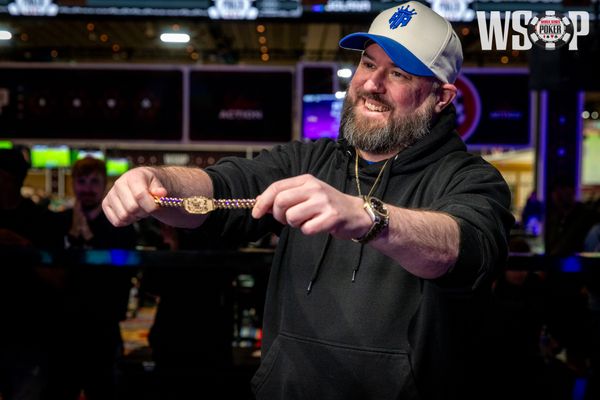
Matt Higgins just proved that circuit grinders can dominate the biggest stages. The nine-time WSOP Circuit ring winner navigated through 22,811 entries—the largest $1,000 buy-in tournament in World Series of Poker history—to capture his first gold bracelet and a seven-figure payday that ended a brutal six-month downswing.
What Happened
The $1,000 Mystery Millions event at the 2026 World Series of Poker created history before crowning its champion. With 22,811 total entries, it became not just the biggest $1K event the WSOP has ever hosted, but the fourth-largest tournament of any buy-in level in poker history.
When the dust settled, Georgia’s Matt Higgins stood atop the mountain with $1,000,000 in prize money and his first WSOP bracelet. The victory came after defeating Poland’s Dominik Panka in heads-up play, capping off a remarkable run that Higgins claims he saw coming the night before.
“What’s really crazy is I knew yesterday,” Higgins revealed moments after his victory. “I came back from dinner, and I had 9.1M chips, and I just started winning, like every hand. Winning all my flips, which is pretty surprising.”
That 9.1 million chip stack ballooned to over 910 million in less than 24 hours as Higgins rode a heater to the finish line. But this wasn’t just another tournament score for the accomplished circuit grinder—it represented redemption after what he described as a $300,000 downswing since winning the Choctaw Main Event last November.
The final table featured an international cast including French player Leo Lombardozzi (third place, $490,000), UK’s Thomas Hall (fourth, $375,000), and American Brian Smith, who turned an eight-big-blind stack into a fifth-place finish worth $290,000. Smith’s run was particularly remarkable given he’d already secured a $100K charity bounty earlier in the tournament.
Four-time WSOP bracelet winner David ‘ODB’ Baker entered the final day second in chips but fell in seventh place for $176,000, his best result of the summer despite missing out on bracelet number five.
The Poker Strategy Breakdown
Winning a field this massive requires more than running hot—it demands strategic adaptability across multiple tournament phases. Higgins’ victory offers several strategic lessons worth examining.
First, consider the tournament structure itself. Mystery Millions events attract recreational players drawn by the bounty element and mystery prize pool distribution. This creates a softer field than comparable buy-in freezeouts, but also introduces variance through the bounty dynamics that can affect opponent decision-making.
Higgins’ comment about “winning every flip” during his late-stage surge highlights a critical tournament reality: deep runs require winning coin flips. In large-field events, you’ll face multiple all-in situations where you’re roughly 50-50. The math is unforgiving—lose two flips in a row and you’re done. Win three straight and you’re suddenly a contender.
The chip accumulation pattern Higgins described—going from 9.1 million to 910 million in under 24 hours—suggests aggressive play during the middle stages when antes create dead money and shorter stacks become desperate. This is where experienced tournament players separate themselves, applying pressure when fold equity is highest.
Circuit grinders like Higgins excel at this phase because they’ve played thousands of hours in similar spots. They recognize when opponents are playing for a ladder-up versus playing to win, and they exploit that fear ruthlessly.
Reading The Field & Table Dynamics
The heads-up battle between Higgins and Panka represented a clash of styles and backgrounds. Panka, a Polish superstar with major tournament credentials, brought big-game experience. Higgins countered with volume—the countless hours grinding circuits that build an intuitive feel for tournament spots.
In fields this large, early survival matters more than chip accumulation. With 22,811 entries, the tournament likely played across multiple Day 1 flights, meaning players faced different field dynamics depending on their starting flight. Some flights play tighter as players try to survive to Day 2, while others feature more gambling as recreational players fire multiple bullets.
The ICM considerations at the final table were particularly interesting. With a $1 million top prize and $640,000 for second, the pay jump created significant pressure. Third place paid $490,000—a $150,000 drop from second. These pay jumps influence every decision, especially for players for whom these amounts are genuinely life-changing.
Higgins’ admission about his recent downswing adds context to his final table approach. A player stuck in a six-month, $300K downswing might play more conservatively, protecting their stack to ensure a significant cash. Instead, Higgins played to win, suggesting either supreme confidence or an understanding that first-place money would be truly meaningful for his future plans.
Brian Smith’s eight-big-blind survival story deserves attention. In tournaments this large, you’ll frequently find yourself short-stacked as blinds escalate. Smith’s ability to spin that stack into a final table appearance demonstrates the importance of short-stack play fundamentals and the willingness to take calculated risks when fold equity disappears.
How To Apply This To Your Game
The strategic lessons from Higgins’ victory translate directly to your tournament approach, regardless of stakes.
Embrace variance while managing it: Higgins acknowledged winning his flips was “pretty surprising,” recognizing the role variance played in his victory. You can’t control whether your aces hold or your flush draw hits, but you can control whether you’re getting your money in good. Focus on making +EV decisions and accept that results will fluctuate.
Develop momentum awareness: Higgins felt his win coming the night before, describing a stretch where he “just started winning, like every hand.” While this sounds like superstition, there’s strategic value in recognizing when you’re catching cards and leveraging that table image. When opponents see you showing down winners repeatedly, they give you more credit, allowing you to steal more pots.
Play the middle stages aggressively: The chip accumulation from 9.1M to 910M didn’t happen by playing fit-or-fold. In large-field tournaments, the middle stages—after the bubble bursts but before the final table—offer the best opportunities to accumulate chips. Players are still thinking about laddering up, creating fold equity you can exploit.
Master short-stack play: Brian Smith’s eight-big-blind recovery proves that tournaments aren’t over until you’re eliminated. Study push-fold charts, understand your shoving ranges from different positions, and don’t give up when short. One double-up changes everything.
Prepare mentally for long sessions: Navigating 22,811 entries requires stamina. Higgins’ circuit-grinding experience prepared him for the mental marathon. Practice maintaining focus during long sessions, take strategic breaks, and develop routines that keep you sharp when it matters most.
Key Takeaways
- Matt Higgins defeated 22,811 entries to win the largest $1K tournament in WSOP history, earning $1,000,000 and his first gold bracelet
- The victory ended a six-month, $300,000 downswing, demonstrating how variance affects even accomplished professionals
- Circuit-grinding experience translates to success in major tournaments through volume-based pattern recognition and situational awareness
- Aggressive middle-stage play is crucial for chip accumulation in large-field events where fold equity is abundant
- Short-stack survival skills matter—Brian Smith turned eight big blinds into a $290,000 fifth-place finish
- Mental preparation and stamina separate winners from survivors in massive-field tournaments
Frequently Asked Questions
How many WSOP Circuit rings does Matt Higgins have?
Matt Higgins has nine WSOP Circuit rings, making him one of the most decorated players on the circuit. His circuit accomplishments include two Main Event titles, a Mini Main Event title, and a Monster Stack title, with nearly $1 million in circuit earnings before this bracelet win.
What was the final prize for winning the Mystery Millions event?
Matt Higgins won $1,000,000 for first place. Second place (Dominik Panka) received $640,000, while third place (Leo Lombardozzi) earned $490,000. The large prize pool reflected the record-breaking 22,811-entry field.
How do you recover from a major poker downswing?
Higgins’ $300,000 downswing over six months shows that variance affects all players. Recovery requires proper bankroll management, maintaining technical fundamentals, avoiding tilt-based decisions, and continuing to make +EV plays regardless of short-term results. Volume eventually allows skill edges to overcome variance.
Final Thoughts
Matt Higgins’ victory in the largest $1,000 buy-in tournament in WSOP history validates a career built on consistent circuit grinding. While the poker world often celebrates high-roller heroes and online phenoms, Higgins represents a different path—one built on volume, experience, and an intimate understanding of tournament poker fundamentals.
His candid discussion of the six-month downswing preceding this win offers a valuable reminder that poker success isn’t linear. Even accomplished professionals face extended losing stretches. The difference between winners and losers isn’t avoiding downswings—it’s maintaining sound strategy and bankroll management until variance corrects.
Perhaps most telling is Higgins’ plan to reduce his playing schedule following this win. After years of grinding, the million-dollar score provides the financial cushion to be more selective about which events to play. For a player with over $3.3 million in career earnings, that’s not about retirement—it’s about optimization and life balance. Sometimes the biggest win isn’t just the money, but the freedom it provides to play poker on your own terms.
Ready to Sharpen Your Poker Game?
Master your poker game with expert hand analysis