WSOP Main Event Stalling Scandal: When Pay Jumps Go Too Far
A shocking display of collusion unfolded at the 2026 World Series of Poker Main Event with 72 players remaining. One player openly announced their intention to stall until a pay jump was secured, while an entire table sat silent. The incident has reignited fierce debate about player responsibility versus tournament director intervention in poker’s most prestigious event.
What Happened
During a critical juncture of the 2026 WSOP Main Event, with 72 players still competing and a significant $20,000 pay increase on the line, an unprecedented situation developed that exposed fundamental issues within tournament poker culture.
A player moved all-in but deliberately left a single chip behind—a tactical move that keeps them in the tournament. The opponent then made a stunning declaration to everyone within earshot: “I am going to let you tank for the pay jump.” This wasn’t a quiet aside or a subtle understanding between two players. It was an open admission of intent to manipulate the tournament structure for mutual benefit at the expense of every other competitor.
What makes this incident particularly troubling is the complete lack of response from the other players seated at the table. Not a single person objected. No one called for floor staff. The collective silence effectively endorsed behavior that fundamentally undermines competitive integrity. For several minutes, actual poker ceased while two players openly coordinated their strategy around pay ladder manipulation.
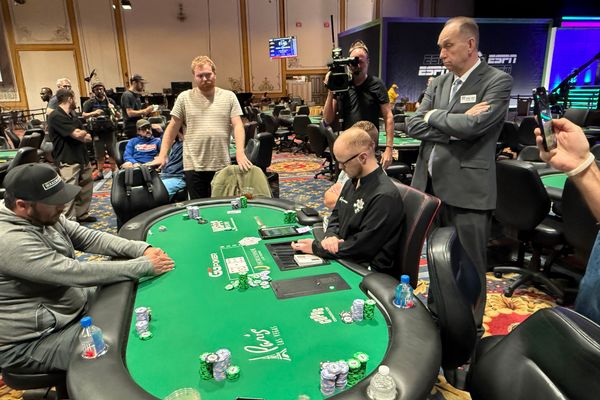
Tournament staff eventually intervened, but the damage to the event’s reputation had already occurred. The incident spread rapidly through poker social media, dividing the community between those who blame tournament directors for inadequate oversight and those who believe players themselves failed their most basic obligation to the game.
The Poker Strategy Breakdown
Understanding why this situation is so problematic requires examining what actually transpired from a strategic perspective. When a player goes all-in leaving one chip behind, they’re making a decision based on their hand strength, stack size, and tournament equity. The opponent must then decide whether to call based on similar calculations.
But the moment one player announces they’ll deliberately stall to help both players secure a pay jump, poker strategy becomes irrelevant. The hand is no longer being played according to the strength of the cards or tournament considerations specific to those two players. Instead, both players are attempting to extract value from the entire remaining field.
This represents textbook collusion. Two players are working together to gain an advantage that comes directly from the pockets of players at other tables who have no ability to defend themselves. Those competitors are playing legitimate poker, making difficult decisions, and taking risks—while two players have simply opted out of competition temporarily to guarantee themselves additional money.
The Independent Chip Model (ICM) calculations that govern proper tournament strategy assume all players are making decisions independently based on their own best interests. When players coordinate, even temporarily, those calculations become meaningless. Every player in the tournament has made decisions based on expected pay jumps and elimination rates that assume everyone is competing. Collusion invalidates those assumptions and effectively steals equity.
Consider the mathematics: with 72 players remaining and a $20,000 pay jump approaching, every player has calculated their expected value based on their stack size and the assumption that eliminations will occur through legitimate poker play. When two players decide to pause competition, they’re increasing their probability of reaching the next pay tier while simultaneously decreasing everyone else’s chances. This isn’t a small edge—it’s a direct transfer of tournament equity.
Reading The Field & Table Dynamics
Perhaps the most disturbing aspect of this incident is what it reveals about table dynamics and player culture at the highest levels of tournament poker. The fact that an entire table of experienced players—competitors who had survived multiple days in the world’s most prestigious tournament—allowed this to happen without objection speaks volumes.
There are several possible explanations for the collective silence. Some players may have been uncertain whether speaking up was their responsibility or whether they should wait for floor staff to intervene. Others might have worried about being perceived as angle-shooting themselves by calling the clock in a strategic spot. Still others may have simply been conflict-averse, unwilling to create confrontation at a final table environment.
But none of these explanations are acceptable. Every player in a tournament has a vested interest in ensuring the competition remains legitimate. When collusion occurs openly and no one objects, it normalizes the behavior and makes future incidents more likely. The silence from the table wasn’t neutral—it was tacit approval.
From an ICM perspective, players at that specific table actually had the most to lose from the stalling. With action frozen at their table, other tables continued playing, meaning eliminations would likely occur elsewhere first. This shifts pay jump probabilities unfavorably for the players who remained silent. They were literally watching their own tournament equity decrease while doing nothing to stop it.
The late-stage tournament dynamics make this even more significant. At 72 players remaining in the WSOP Main Event, every decision carries enormous financial weight. Players have invested days of their lives and navigated thousands of competitors to reach this point. The suggestion that they would passively accept collusion at this stage indicates either a fundamental misunderstanding of their rights and responsibilities, or a troubling acceptance of unethical behavior when it’s presented openly rather than concealed.
How To Apply This To Your Game
Whether you play local tournaments or major championship events, understanding your role in maintaining game integrity is crucial. Here’s how to handle similar situations and protect both yourself and the field.
First, recognize that you have standing to object to any behavior that affects tournament integrity, even if you’re not directly involved in the hand. If you observe obvious stalling or hear players discussing coordination, immediately call for floor staff. You don’t need to make accusations—simply request a clock or ask for a floor person to observe the situation.
Second, understand that calling the clock is not angle-shooting when the delay is clearly excessive and strategic rather than based on a difficult decision. In fact, failing to call the clock in obvious stalling situations makes you complicit in the behavior. Tournament rules exist to protect all players, and you have every right to invoke them.
Third, if you’re ever tempted to engage in similar behavior yourself—or if another player suggests coordinating around pay jumps—remember that this constitutes collusion regardless of how openly it’s done. The fact that something is announced publicly doesn’t make it ethical or legal under tournament rules. Collusion is collusion whether it’s whispered secretly or declared openly.
For tournament directors and floor staff, this incident provides a clear lesson: high-stakes situations require increased vigilance. When significant pay jumps approach, having floor presence at every table becomes essential. Additionally, being willing to call the clock proactively rather than waiting for player requests can prevent these situations from developing.
The newly adopted TDA chip penalties for time violations provide an excellent tool for addressing this behavior. A five-big-blind penalty for obvious strategic stalling creates real consequences that make the behavior -EV rather than profitable. Tournament staff should not hesitate to apply these penalties when warranted.
Key Takeaways
- Open collusion occurred at the 2026 WSOP Main Event when a player announced their intention to stall for a pay jump, with no objection from the table
- This behavior directly steals equity from all other tournament participants who are playing legitimate poker
- Players have a responsibility to police game integrity themselves, not just rely on tournament staff to catch every violation
- Calling the clock in obvious stalling situations is not angle-shooting—it’s protecting the integrity of the competition
- New TDA chip penalties for time violations provide tournament directors with effective tools to disincentivize strategic stalling
- The silence from other players at the table was as problematic as the collusion itself, as it normalized unacceptable behavior
Frequently Asked Questions
Is it ever acceptable to play slowly near a pay jump?
Taking time to make a genuinely difficult decision is always acceptable, regardless of pay jump proximity. However, deliberately stalling when you’ve already made your decision, or coordinating with another player to delay action, crosses the line into rule violations. The distinction is between legitimate decision-making time and strategic manipulation of the tournament clock.
What should I do if I witness obvious collusion at my table?
Immediately call for floor staff and request they observe the situation. You don’t need to make formal accusations—simply asking for floor presence is sufficient. If you observe strategic stalling, you also have the right to call the clock on a player, which starts a countdown timer for their decision. Don’t remain silent when you witness behavior that affects tournament integrity.
Can tournament directors penalize players for stalling?
Yes. The Tournament Directors Association recently adopted chip penalties specifically for time violations and excessive stalling. Floor staff can assess penalties ranging from one orbit away from the table to multiple big blinds removed from a player’s stack. These penalties are designed to make strategic stalling unprofitable and protect the integrity of tournament competition.
Final Thoughts
The 2026 WSOP Main Event stalling incident represents a watershed moment for tournament poker. It exposed uncomfortable truths about player culture and the willingness of even experienced competitors to tolerate behavior that fundamentally undermines competitive integrity. The poker community now faces a choice: either players take responsibility for policing themselves, or tournament structures will need to implement increasingly restrictive rules that affect everyone.
The ideal solution involves shared responsibility. Tournament directors must maintain vigilance during high-pressure situations and be willing to intervene proactively when obvious violations occur. But players themselves must also recognize that remaining silent in the face of collusion makes them complicit. Speaking up isn’t creating drama—it’s protecting your own equity and that of every other competitor who’s playing the game honestly.
Moving forward, incidents like this should serve as teaching moments. New players need to understand that tournament poker isn’t just about making correct strategic decisions with your own hands—it’s about maintaining an environment where everyone competes fairly. Experienced players need to model that behavior by refusing to tolerate violations, even when intervention might feel uncomfortable. Only through collective commitment to integrity can tournament poker maintain the legitimacy that makes it worth playing in the first place.
Ready to Sharpen Your Poker Game?
Master your poker game with expert hand analysis