Annette Obrestad’s WSOPE Return: Strategy Lessons From a Legend
Annette Obrestad navigated Day 3 of the WSOPE Main Event with the same fearless aggression that made her a poker icon nearly two decades ago. After an eight-year hiatus from major tournaments, the 2007 WSOPE Main Event champion bagged over 1 million chips, demonstrating that elite poker instincts don’t fade—they evolve.
What Happened
Day 3 of the record-breaking WSOPE Main Event witnessed something special: Annette Obrestad reminding the poker world why she became a legend in the first place. Playing her first major tournament since 2018, Obrestad battled through a grueling day with a below-average stack, showcasing the aggressive style that defined her early career.
The Norwegian poker prodigy, who famously won the inaugural WSOPE Main Event at just 18 years old, faced constant pressure throughout the session. Her most notable hand came against Lazare Kalebashvili, where she executed a triple-barrel bluff that nearly succeeded. Holding K♥9♥ against Kalebashvili’s A♦Q♣, Obrestad fired on all three streets despite her opponent flopping top pair on an A♣6♥3♠ board.
After betting 20,000 on the flop and 55,000 on the 4♥ turn—which gave her a flush draw—Obrestad shoved the river for Kalebashvili’s remaining 267,000 chips. The Georgian player tanked extensively before making the hero call to scoop a 622,000-chip pot.
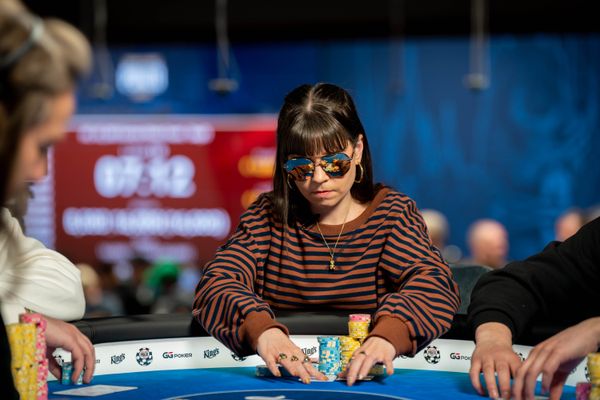
Despite setbacks, Obrestad survived multiple all-in situations, including a crucial hand where her A♥J♥ held against pocket nines after spiking a straight. By the time 85 players bagged for Day 4, she had accumulated 1,025,000 chips—good for 65th place and approximately 34 big blinds heading into the next session.
Obrestad wasn’t the only woman making waves. Shiina Okamoto, a back-to-back WSOP Ladies Championship winner, bagged an impressive 3,130,000 chips, placing her 15th overall with over 100 big blinds. Both women are now positioned to make serious runs at WSOPE history.
The Poker Strategy Breakdown
Obrestad’s triple-barrel bluff against Kalebashvili offers a masterclass in aggressive tournament play—and also highlights the fine line between brilliance and disaster in modern poker. Let’s dissect this hand from multiple angles.
The flop continuation bet was standard. With K♥9♥ on an A♣6♥3♠ board, Obrestad held backdoor flush potential and two overcards to the sixes and threes. Against most opponents, this board heavily favors the preflop aggressor’s range, making a small continuation bet profitable regardless of actual hand strength. Her 20,000 bet into what was likely a pot of similar size represented a textbook exploitation of range advantage.
The turn 4♥ changed everything. Obrestad now had nine clean outs to the nuts with her flush draw, plus potential overcard outs if Kalebashvili held a weaker ace or was floating with a pocket pair. Her 55,000 bet served dual purposes: building the pot with equity and maintaining fold equity against marginal holdings. This is where elite players separate themselves—they don’t just bet their draws passively; they weaponize them.
The river shove, however, is where opinions diverge. When the flush draw bricked, Obrestad faced a decision: give up on a pot of roughly 150,000 or fire a third barrel representing the very top of her range. She chose maximum aggression, moving all-in for Kalebashvili’s remaining stack.
From a game theory perspective, this play has merit. Obrestad’s range on the river should contain value hands like aces with strong kickers, overpairs, and two-pair combinations. By including some bluffs—particularly hands that picked up equity on the turn like flush draws—she maintains balance and prevents opponents from exploiting her by calling down light.
The execution, however, revealed a potential miscalculation. Kalebashvili’s call on the turn with top pair and a mediocre kicker signaled strength and commitment. Players don’t typically call large turn bets with the intention of folding rivers unless a dramatic card arrives. The river blank meant Kalebashvili’s hand didn’t get worse—making him an unlikely candidate to fold.
A more exploitative approach might have recognized Kalebashvili’s turn call as a commitment point and checked the river to preserve chips. But tournament poker isn’t played in a vacuum, and Obrestad’s aggression sends a powerful message to the entire table: she’s not here to play scared.
Reading The Field & Table Dynamics
When asked about the evolution of tournament poker during her absence, Obrestad noted increased aggression, more three-betting, and more four-betting compared to her previous era. This observation is crucial for understanding her strategic adjustments.
Modern tournament poker has undergone a significant transformation since the late 2000s. Solver-influenced strategies have pushed players toward higher frequencies of aggression, particularly in position. The days of waiting for premium hands are largely gone at the highest levels—replaced by a game of ranges, blockers, and relentless pressure.
Obrestad’s willingness to fire three barrels demonstrates her adaptation to this new reality. She’s not playing 2007 poker; she’s incorporating contemporary aggression while leveraging her decades of experience reading opponents and situations.
The ICM considerations on Day 3 also played a significant role. With 85 players remaining from a massive field, pay jumps become meaningful but not yet critical. This is the stage where accumulating chips matters more than survival—a concept Obrestad clearly embraced. Her all-in with A♥J♥ against pocket nines wasn’t reckless; it was calculated aggression at a tournament stage where doubling up provides exponentially more value than laddering up a few spots.
Table dynamics also favored aggressive play. When Patrick Leonard and other poker luminaries are watching and commenting on your return, there’s an intangible psychological advantage to playing fearlessly. Opponents know Obrestad’s history and reputation—that knowledge alone generates fold equity.
How To Apply This To Your Game
Obrestad’s Day 3 performance offers several actionable lessons for tournament players at all levels.
First, understand when to apply maximum pressure. Obrestad’s triple-barrel bluff wasn’t random aggression—it was a calculated sequence based on board texture, position, and opponent tendencies. Before firing multiple barrels, ask yourself: Does my range support this line? Does my opponent’s range contain enough hands that can fold? Have I built a credible story?
Second, embrace variance at the right tournament stages. With 85 players remaining and a below-average stack, Obrestad correctly identified this as a chip accumulation phase rather than a survival phase. Too many players tighten up prematurely, missing opportunities to build stacks when ICM pressure is still manageable. If you’re sitting on 30-40 big blinds in the middle stages, you should be looking for spots to double up, not trying to ladder into the money.
Third, balance solver-based strategies with exploitative adjustments. Obrestad acknowledged the game’s evolution toward more aggression but also emphasized that “it’s still poker.” The fundamentals of hand reading, opponent profiling, and situational awareness remain paramount. Don’t get so caught up in GTO frequencies that you miss obvious exploitative opportunities.
Fourth, manage your table image deliberately. Obrestad’s aggressive play early in the day—even when unsuccessful—established her as a force to be reckoned with. This reputation likely helped her win pots later without showdown. If you’re going to bluff, make sure your table sees it (when you get caught) or suspects it (when you show down marginal hands). This investment in image pays dividends in future spots.
Finally, trust your instincts in crucial moments. When Obrestad went all-in with A♥J♥ against pocket nines, she said, “I’ve got a good feeling.” While we shouldn’t romanticize gut feelings over mathematics, experienced players develop pattern recognition that manifests as intuition. If you’ve put in the work studying poker, trust yourself in marginal spots.
Key Takeaways
- Triple-barrel bluffs require careful consideration of opponent tendencies, stack depths, and board runouts—not every draw that misses should turn into a bluff
- Modern tournament poker demands higher aggression frequencies, but exploitative adjustments based on opponent profiles remain crucial
- The middle stages of tournaments (before significant ICM pressure) favor chip accumulation over survival—this is when to take calculated risks
- Table image is a strategic asset that can be cultivated through selective aggression and carefully chosen showdowns
- Returning to poker after extended breaks is possible when fundamental skills are strong—the game evolves, but core concepts remain constant
- Position and range advantage justify continuation betting on most flops, but later streets require more precise hand reading and opponent profiling
Frequently Asked Questions
When should you fire a triple-barrel bluff in tournament poker?
Triple-barrel bluffs work best when you have a credible range story, your opponent has shown medium strength (not committed but not weak), and the board texture supports your represented holdings. Key factors include your table image, stack depths relative to the pot, and your opponent’s tendency to make hero calls. Generally, triple barrels are more effective against thinking players who can fold strong hands than calling stations who can’t release top pair.
How has tournament poker strategy changed since the late 2000s?
Tournament poker has evolved toward significantly more preflop aggression, with higher frequencies of three-betting and four-betting. Solver-based strategies have revealed that many previously standard plays were too passive. Modern players understand range advantage better, apply more pressure in position, and use smaller bet sizing to achieve similar fold equity while risking fewer chips. However, fundamentals like hand reading, position awareness, and opponent profiling remain as important as ever.
What stack size requires shifting from chip accumulation to survival mode?
This depends heavily on tournament stage and payout structure, but generally, you should prioritize chip accumulation until you reach the final 15-20% of the field or when pay jumps become significant relative to your buy-in investment. With 30-40 big blinds in the middle stages, you’re in prime territory for aggressive play and doubling up attempts. Once you’re in the money with 15-20 big blinds, ICM considerations become more important, though you should never play so tight that you blind down to desperation.
Final Thoughts
Annette Obrestad’s return to high-stakes tournament poker represents more than nostalgia—it’s a testament to the enduring value of fundamental poker skills combined with strategic evolution. Her willingness to embrace modern aggression while maintaining the fearless creativity that defined her early career demonstrates that great players can adapt across eras.
The triple-barrel bluff against Kalebashvili, while unsuccessful, showcased the kind of calculated aggression that builds championship stacks. Not every big bluff needs to work for your overall strategy to be profitable. What matters is maintaining the right frequencies, choosing appropriate spots, and learning from each outcome. Obrestad’s ability to bounce back from that setback and navigate to Day 4 with a playable stack exemplifies the mental resilience required for deep tournament runs.
As Day 4 approaches with 85 players remaining, both Obrestad and Shiina Okamoto carry the hopes of poker fans worldwide. Whether either woman can capture WSOPE glory remains to be seen, but their presence at this stage proves that skill, preparation, and fearless execution still determine tournament success. For players looking to improve their own game, studying how elite competitors like Obrestad balance aggression with discipline offers invaluable insights that transcend any single hand or session.
Ready to Sharpen Your Poker Game?
Master your poker game with expert hand analysis